Wednesday, August 5, 2009

Destruction of Takshashila – a defining moment

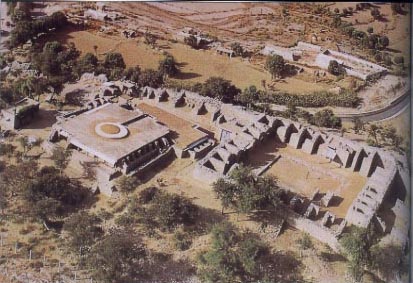
The importance of Takshashila

As the oldest university in the world, Takshashila has a special place in the history of the world. More so, in Indian history. It's destruction (purportedly) at the hands of the Hunas, as proposed by Western historians (and their followers) has been rather facile - to say the least.

There is evidence that the truth may be otherwise. This post lays out an alternative scenario, but before let us refresh ourselves with the history of Takshashila.

Takshashila in classical texts, history, geography

The Vayu Purana traces the start of Takshashila, to Taksha, son of Bharata (brother of Raghu Ram Chandra). Takshashila also finds a mention in Mahabharata - citing Dhaumya, as the acharya of Takshashila. It was at Takshashila, that Vaishampayana made the first recorded narration of the Mahabharata to Janmajeya.

It finds continued mentions in numerous Jatakas, too. For centuries, across many cultures, stories of Takshashila (and its environs) swirled, like even later,

According to a story contained in the Mujma-t-Tawarikh a twelfth-century Persian translation from the Arabic version of a lost Sanskrit work, thirty thousand Brahmans with their families and retinue had in ancient times been collected from all over India and had been setttled in Sindh (from Al-Hind, the Making of the Indo-Islamic World By André Wink).

The Buddhist anthology of stories, Avadana-shataka mentions that "3.510 millions of stupas were erected at the request of the people of Taxila".

Students paid 1000 coins in advance to receive education at Takshashila - and there were thousands of such students. Students came from all over the world – and paid large sums of money to Indian teachers for education! Kings, brahmans, commoners - all came to study at Takshashila. Its alumni included all the stars of the Indian firmament - Atreya, Pasenadi, Mahali, Patanajali, Jivaka, Panini, Kautilaya, Prasenjita.

Its development and importance lay in the fact that,

Takshashila and Purushpura on either side of the Sindhu river were connected with the Indian trade routes on the Indian side and Central Asian trade routes on the other. Strategically located, Takshashila, the capital of Gandhar, was the terminus of several inland routes and the starting points of the great trade routes connecting India and Central Asia. (from India and Central Asia By J. N. Roy, Braja Bihārī Kumāra, Astha Bharati (Organization)).

Based on subsequent excavation and diggings, it is thought that Takshashila was the oldest city in South Asia - when Alexander landed there. So Takshashila's historic and cultural importance is too high to become a victim of slip shod colonial propaganda - posing as history.

Chinese travellers to India

An important source for 'modern' history, much used by Western historians are the travels of Chinese travellers (like Fa Hian/ Faxain, Huien Tsang /XuanZang). Supposedly 1000 years after death of Gautama Buddha, overlooking some gaping holes in Fa Hian's travelogue.

How could Fa Hien miss meeting /mentioning Kalidasa - supposedly a contemporary of Fa Hien? In fact, Kalidasa is not mentioned at all in Fa Hian's account, which supports the hypotheses that Kalidasa preceded Fa Hian. It may be pointed out that since, Kalidasa's works are artistic rather than religious or philosophical, the lack of Fa Hain's interest in his works is obvious. But to ignore a man of Kalidasa's stature and learning?

Then Fa Hian misses the name of the supposed ruling 'Gupta' king - a dynasty which ruled over most of South Asia! And it is Fa Hian who is supposedly a significant authority on the Gupta period. Western history labelled the Gupta period as the 'golden age' of Indian history - which Fa Hian seems to have completely missed. Similarly when Fa-Hien visited Takshashila in 5th century AD (travelled in India during 399-414 AD), he found nothing. His travelogue makes some cursory mentions of Takshashila.

And that leaves Indian history with some rather big 'dating' holes! Is it that Fa hian visited India much after Kalidasa, the Gupta dynasty, the death of Buddha? Maybe a few centuries later, relative to the period in Indian history. Fa Hian's date is well indexed. So that possibly cannot move much. It is the the corresponding Indic dates which come into question!

Another Chinese traveller, Sung Yun, who had a rather exalted view of his country and its ruler, is largely responsible for overly negative image of the Hunas in 'modern' history. Sung-Yun's peeve - the Huna king did not read the letter from the Wei Tartar king standing, but in a seated position. A modern historian writing on the spread of Buddhism and Buddhist traveller's tales thinks that,

Like most things India it (Buddhism) suffered somewhat from the invasions of the Huns, who dominated many parts of the northwest from 480 to 530; but the immediate effect of their depredations does not seem to have been very striking. At any rate, the Chinese pilgrim Sung Yun, who travelled through this region in 518-21, gives us a picture in which Buddhism is quite as thriving as it was in Fa-Hien's time. (from The Pilgrimage of Buddhism and a Buddhist Pilgrimage By James Bissett Pratt, page 111).

Subsequent Chinese travellers to India like I Ching (I Ching or Yi Jing, Yìjìng, Yiqing, I-Tsing or YiChing), were more about Buddhism the religion that it had become, instead of a school of learning and thought. I Ching also recorded details of the works and life of Bhartrhari, the (probably) 5th century grammarian and poet. His take away from India, from Nalanda "in ten years (A.D. 675-685), during which he collected there some 400 Sanskrit texts amounting to 500,000 slokas."

The 'end' of Takshashila

The colonial narrative of traces the destruction of Takshashila in 499 AD, by the Hunas (Western history calls them White Huns, Romans called them Ephtalites; Arabs called them the Haytal; The Chinese Ye Tha). Western 'historians' have ascribed the demise of Taxila to the White Huns, a Central Asian, nomadic tribe, roaming between Tibet to Tashkent, practicing polyandry.

Takshashila lying at the cross roads of the Uttarapatha (West calls it The Silk Route) – from Tibet, China, Central Asia, Iran – and India, fell to this mindless savagery, goes the 'modern' narrative. But specifically, there is no mention in Chinese, Persian, Indian texts (that I could find) of the Hunas who destroyed Takshashila. So, how and where did this story spring from?

Kanishka, a major Buddhist king, was a Yue Chi, known as Tusharas in India, related to the White Huns. Why would his tribal cousins destroy Takshashila?

History as propaganda

We have the 'imaginative genius' of Sir John Marshall to thank for this - a man who was "interested in Alexander's campaign and in Graeco Buddhist monuments at Sanchi and Taxila." Sir John, who was "filled with enthusiasm for anything Greek" was also aware that it was at "Taxila that Alexander the Great halted and refreshed his army before advancing to do battle with Porus." Not one to stoop below self-aggrandisement, he is among the "few archaeologists now living who have devoted as many years to the excavation of a single site as I have devoted to Taxila." He lays out the ground for the 'destroyer White Huns' theory, describing how

the hordes of Ephthalites or White Huns which swept over Gandhara and the Panjab in the third quarter of the fifth century, carrying ruin and desolation wherever they went. (from Taxila - an illustrated account of archaeological excavations By Sir John Marshall page 76).

And his evidence for this destruction is,

Thirty two coins, all of them silver, leave no room for doubt it was it was the White Huns who were responsible for the wholesale destruction of the Buddhist sangharamas of Taxila ... several skeletons of those who fell in the fight, including one of White Hun, were lying. (ellipsis mine; from Taxila by Sir John Marshall page 791).

Join the gang!

A chorus of historians joined in Sir John's smear campaign (published between 1940-1951) against the White Huns who were 'guilty' of 'destruction of Takshashila'. Sir John lays the burden of guilt at the doorstep of the Hunas (Western history calls them White Huns, Romans called them Ephtalites; Arabs called them the Haytal; The Chinese Ye Tha). Based on traveller's tall tales, we have 'modern' historians who have depicted, without any evidence, that the

the White Huns, or Hephtalites, felt a kind of hatred toward Buddhism and strove to destroy all its physical as well as mental manifestations during the fifth century. This is how Taxila brutally vanished. (from Books on fire: the destruction of libraries throughout history By Lucien X. Polastron, Jon Graham page 107-108).

And this is from a book which claims to be a "historical survey of the destruction of knowledge from ancient Babylon and China to modern times". Another book seeking to capture Central Asian history writes that these Hunas, who came,

sacking monasteries and works of art, and ruining the fine Greco-Buddhic civilization which by then was five centuries old. Persian and Chinese texts agree in their descriptions of the tyranny and vandalism of this horde.” (from The Empire of the Steppes By Rene Grousset, Naomi Walford).

It has been pointed out that

Although the exact relationship between the Buddhist communities of the Peshawar basin and the new Hun dynasty is not entirely clear, there is considerable evidence to suggest that Buddhism continued under Hun rule ... (there is) textual evidence to show that Chinese Buddhist pilgrims continued to visit Gandharan sites in the Peshawarn Basin into the early sixth century C.E.; The Bhamala main stupa can be compared to the 7th to 8th century cruciform stupas in Kashmir, Afghanistan, and other parts of Central Asia. (from The Buddhist architecture of Gandhāra By Kurt A. Behrendt pages 207-209).

Technically, it was also pointed out that Sir John did not stratify his digs, which creates a dating and sequencing problem. Going with self-aggrandizing nature, Sir John also focussed on 'glamourous digs' - without focussing on the connectivity issues.

Alexander in colonial historical narrative

For more on the decline of Takshashila, it is Alexander that we must turn to.

Alexander has long been a vital cog in Western colonial narrative of history. Alexander’s halo gave bragging rights – first to the Greco-Romans and then to the Euro-colonialists.

The American Department of Defense, in its Legacy Program, has a section on Cultural Heritage Training. The use of Alexander’s mythos there is self evident. Between the Greco-Roman historians and the Euro-Colonialists, has sprung an entire industry, to create a mythos surrounding Alexander.

Amongst Alexander’s first actions in India were his attempts to cobble up alliances. His most famous one was with Ambhi – the ruler of Taxila. In India, Alexander had to pay the King of Taxiles, Omphis, (Ambi) 1000 talents of gold (more than 25 tons of gold) – to secure an alliance. To cement this alliance, Alexander ‘gifted’ Ambhi with ‘a wardrobe of Persian robes, gold and silver ornaments, and 30 horses, 1000 talents in cash’. 1000 talents is anywhere between 25,000-60,000 kg of gold! Does this look like Ambhi accepted Alexander as the conqueror of the world – or Alexander ‘persuading’ Ambhi to seal an alliance?

The payment of 1000 talents in gold to Ambhi aroused much envy and outrage in Alexander’s camp. It prompted Meleager, to sarcastically congratulate Alexander for ‘having at least found in India a man worth 1000 talents.’ What seals this incident is Alexander’s retort to Meleager, “that envious men only torment themselves.” (C 8.12.17 & 18).

Black and blue

Instead of the complete capitulation and collaboration that Alexander got from the defeated Achaemenid ruling family of Sisygambis, Stateira, Oxathres (brother of Darius III; also written as oxoathres and oxyathres) et al, the foursome of Bessos, Spitamenes, Datafernes and the Scythians made Alexander’s life miserable. At Gaugamela, it was Bessos and his Indian cavalry, which broke Alexander’s formations. As a 19th century historian reports,

During the three years anterior to the passage of the Indus, Balk (Bactria) was usually Alexander's headquarters. It was in these countries that he experienced his only serious reverses in the field. (from On the practicability of an invasion of British India By Sir George De Lacy Evans).

The tribes and kshatrapas (satraps) of Indian North West swath, delayed Alexander for nearly three years – before he could step into India. In India, Alexander had to pay the King of Taxiles, Omphis, (Ambi) 1000 talents of gold (more than 25 tons of gold) – to secure an alliance. He had to return the kingdom of Punjab to Porus – purportedly, after winning the battle. His loot and pickings from India were negligible.

To these lean pickings, Alexander’s reaction – “the Macedonians frequently massacred the defenders of the city, especially in India.” What was Alexander's response to a ‘sub-continent occupied by a complex network of peoples and states, who viewed Alexander as a new piece to be played in their complex political chess game.' Another modern historian, an expert on Greek history writes that 'the tale of slaughter told in the ancient sources is unparalleled elsewhere in the campaign.' ( from Ancient Greece By Sarah B. Pomeroy, Stanley M. Burstein, Walter Donlan).

The Indian reaction

Alexander's massacres in India, a colonial historian informs us (without naming a source), earned him an "epithet ... assigned (to) him by the Brahmins of India, The Mighty Murderer." This Indian Brahmanic characterization of Alexander, commonly taught to English schoolchildren and present in Eglish college texts, as The Mighty Murderer, curiously disappeared from Western-English texts soon after 1860 - and instead now "a positive rose-tinted aura surrounds Alexander" ... !

Greek writers report, that Alexander finally realized that it was the Indian Brahmins who had influenced Indian princes to organize and support the Indian war against Alexander. Greek sources cite, after this realization, at ‘The City of Brahmans’, Alexander massacred an estimated 8000-10,000 of these non-combatant Brahmans. His question-answer sessions with the 10 Indian-prisoners-Brahmans (called Gymnosophists by the Greeks), related by Plutarch, shows Alexander at sea, completely lost.

And arising from this frustration, came Alexander's wanton massacres at Takshashila - which thereafter limped along for the next 1000 years, but never to fully recover.

More questions on the destruction of Takshashila

At the time of Takshashila's decline in the 5th century, a significant Gupta king was Purugupta - successor of Skandagupta. Written records from Purugupta's reign are few and far in between, he has been variously named as Vikramaditya, Prakashaditya and of course as Puru /Pura Gupta.

The most authentic link to his reign is the Bhitari seal inscription, (near Ghazipur, in modern UP). The Bhitari seal provided proof of an elongated Gupta reign - than the Skandagupta-was-the-end-of-Gupta dynasty dating. Currently dated between 467 AD, Purugupta's reign saw many border wars.

Purugupta's reign saw Vasubandhu, a known teacher of logic and debate, become famous and Huien Tsang reported on the debates based on Vasubandhu's texts. Today Vasubandhu's texts exist in Chinese and Tibetan languages - the original Sanskrit volumes remain untraceable. Purugupta also restored the gold grammage in the ‘suvarna' coins, probably debased in Skandagupta's time, possibly due to the cost of the fighting the Hunas.

Is it that the Porus identified by the Greeks, Purugupta? Were the marauding soldiers, mentioned in Chinese texts, mercenary soldiers hired by Alexander to replace the 'deserting Greek' soldiers, on the eve of his Indian 'campaign'? The dating of the Gupta dynasty to end of the 5th century AD, is probably off by about 800 years.

The Indian defence system

Taksashila's destruction raises an obvious question! And also important. What did Indian polity do to defend centres of excellence like Takshashila?

To protect such a vibrant and important centre of leaning, the Indian polity had evolved a complex structure across the entire North Western swath. Thus while, within the Indic area, borders and crowns kept changing and shifting, invaders were kept at bay. A system of alliances supporting frontline kingdoms in the entire North West Indian swath was formulated.

For instance, against the Assyrian invasion, led by Semiramis, a minor Indian king, Stabrobates, was supported to beat back the Assyrian invasion. Against Cyrus the Great, Tomyris, a Scythian Queen was supported to massacre Persian invaders. Alexander’s nightmare began immediately, as soon as he crossed from the Persian area into the area governed by the Medes - an Indic area.

A symbol of these alliances, for instance, was the House of Suren’s traditional rights to install the crown of Persian rulers. Some ancient maps show the Gandhara-Takshashila region as Suren. And it was at the hands of these very Surens that Crassus met his nemessis. At the hands of the Indo-Parthian armies - led by a Suren general.

The Sassanian dynasty was able to wrest back and defend Persian dominions from the Greco-Romans, after setting up an elephants corps in their army – evidenced, for instance, by the carvings at Taq-i-Bustan. At one time, the Sassanian rulers had increased its elephant corps to 12,000 elephants.

End of Crassus

Less than 300 years after Alexander, Romans came close to Indian border. They were led by Marcus Licinius Crassus – estimated (or allegedly) worth 200,000,000 sestertii. A writer of classical journals estimated that to be worth about 7.6 million in 1860. Inflation adjusted, about 7.6 billions. Source of Crassus’ wealth – slavery, corruption, pillage, bribery et al. Crassus is more famous in history for three things – One, for his wealth, Two – for having crucified thousands of rebellious slaves on the Via Appia, after defeating Spartacus’ Slave Army and Three, as the man who funded the rise of Julius Caesar.

It is his death, that is usually glossed over.

Roman forces retreated, when confronted by Indo-Sassanian armies with Indian elephants. For the next nearly 400 years, Romans were wary of any large expeditions into Indo-Persian territories. 500 years later (nearly), with the help of the Indian elephant corps, the Sassanians stopped the Romans at Persian borders in 363 AD. But it is interesting that the enemies of the daiwas (enemy of devas are the asuras, in Indian scriptures), the Zoroastrians (followers of Ahura Mazda, speculatively Mahishasura) allied themselves with a Suren. A 1000 years later, the Sassanian army, had forgotten their lessons – and could not use their few elephants to full effect, against the Islamic Arabs.

The rise of religion in India

Without access to the 'Indian thought factory', after the fall of Takshashila, in 499 AD – by the Huna (dating as per Western history which calls them White Huns, Romans called them Ephtalites; Arabs called them the Haytal; The Chinese Ye Tha) Buddhism soon became a religion. Buddha in India, was another, in a long line of teachers. But in the rest of world, Buddhism soon became a religion.

The destruction of Takshashila (Taxila) meant that students and scholars would need to travel for an extra 60 days to reach the other Indian Universities of the time. This was a traumatic event in the status of the Indian ethos - even the Asiatic ethos.

The decline of Taksashila marked the destruction, persecution and decline in Indian education, thought and structure. Fewer believers in Indian faith systems made the trip to India. ‘Consumers’ of ideological products from the ‘Indian Thought Factory’, were left with Desert Bloc alternative products. Buddhism soon became a religion outside India. A few centuries after decline of Takshashila, Nalanda, etc. were also destroyed by Desert Bloc invaders.


Travels of Fah-Hian and Sung-Yun, Buddhist pilgrims from China to India (400 ...


By Samuel Beal

Tuesday, August 4, 2009

As the sun set on the Raj ...

One evening in early August 1943, Brigadier General Mortimer Wheeler was resting in his tent after a long day of poring over maps, drawing up plans for invasion of Siciliy. Mortimer Wheeler was invited to become the director general of archaeology by the India Office of the British government in its last years of rule in South Asia ...Summoning a general from the battlefields of Europe was an extraordinary measure, an admission both of the desperate condition of Indian archaeology and an acknowledgment of its vital importance. (from The Strides of Vishnu: Hindu Culture ... - Google Books).

Amazing!

This is one question that has long puzzled me!

Why would the glorious British Empire, on which the sun never set, struggling for its very existence, in the middle of WW2, suddenly pull a general back from the battlefield - and put him into archaeology! Especially, when it was clear that they would be departing from India - sooner rather than later.

Just why

Considering what theories came from Mortimer Wheeler's rather fertile 'imagination' and his rigourous archaeological process, raises even more questions. There may be the facile answer that the British were after all 'searching for history and truth'.

It is this one incident which possibly contains answers to many unanswered questions like: -

  1. The amount of energy expended by the West in defending the Aryan Invasion /Migration Theory,

  2. The lack of access to Indian scholars of the archaeological sites in Pakistan,

  3. The many myths in Indian history,

  4. The clues to the partition of India

  5. The dating problems
et al.

Again ... just why?

Just why would an imperial power, struggling for its very existence, suddenly pull a general from the battle field, in the middle of WW2 - and put him onto the job of digging dirt.

Only one explanation fits - it had to be a struggle for a existence at a higher level!

Thursday, July 30, 2009

Indic Justice – The need to rediscover or reinvent?

Indic Justice ...

The on-going saga of the Ambani brothers' dispute, brings home how deeply and completely Indic norms of justice and fair play have been lost. The Ambani brothers have approached the Prime Minister and are pressing their cases in the Supreme Court for justice. Such a form of dispute redressal is alien and remote to Indic thought.

The other apparently unrealted 'event' is the much promoted and publicised book, The Idea of Justice by Amartya Sen, has no clue about justice (at least on Indic thoughts on justice). Apart from a few token mentions about Ashoka Maurya and Akbar Moghul, he has very little to say about Indic thought on justice. But he speaks very volubly on Western thinkers and thought on justice.

The wise king delivers justice

To bring out the contrast, one has only to read the Biblical story of King Solomon's justice (where two prostitutes claimed the surviving baby as theirs). The point worth noting is that this paradigm of justice centralizes solutions and concentrates power in the hands of some central authorities.

So, whether it King Solomon or Caliph Haroun Al Rashid (the King in disguise), or the Turkish Çapanoglu Ahmet Pasha (of the justice bell fame which even a donkey could ring to summon the king for justice) - the model was the all-knowing King.

Going back earlier, the Desert Bloc model of seeking justice was captured in the story of Tehuti-nekht (the oppressive overseer); a 'sekhti' (the poor salt-trader) the 'clever' Meruitensa (The Grand Vizier /Supreme Judge) and The Wise Pharoah Nebkanra.

All quiet on the Indian front ...

In more than 1000 Indic books, claiming to record more than 10,000 years of history, there is no instance of any dispute reaching the King. The longest ancient epic in the world, The Mahabharata has no incident where a private dispute reached Yudhisthir (though a mongoose could lecture the King about sacrifices and yagnas). There was never any case of private dispute, recorded in the Ramayana, that reached Ramachandra (though a dhobi could 'inform' the king about bazaar talk regarding the Queen Sita). Even a poor Brahman, Kautsa, could reach King Raghu for help in the disbursal of guru-dakshina गुरु दक्षिणा।

Is it that Indians were ‘saints' and did not have private disputes? Were they so civilized that they could solve all disputes by talking to each other? Is it that Indian kings were not bothered about delivery of justice!

It gets worse! No prisons ...

Modern econometric modelling has an interesting perspective on Indian economy where research shows that for much of the last 1000 years, India has been a significant economic power till the 1900.

China and India, this analysis estimates, for the last 1000 years, accounted for 50% of the world economy. Statistical analyses showed India with a world trade share of 25% for much of the 500 years during 1400-1900. With this prosperity, the most interesting (historical) aspect of the criminal management story is the absence of any surviving mass jails in India prior to colonial India.

Without prisons, just how did pre-colonial India, one of the largest (and most prosperous) populations of the world, deal with crime and criminals?

But then crime rate in India must be really high ...

And have the lowest prison population in the world? How can India have such a low prison population, with a poor police-to-population ratio and a crime rate which is not above the average – in spite of a large civilian gun population.

All the 5 indices (below) create a bias for a lawless Indian society and rampant crime. With these five indices, namely: -

  1. Police to population ratio (’increase police force’).

  2. Prison population (’put more criminals behind bars’)

  3. Capital punishment (’kill enough criminals to instill fear’)

  4. Poverty (’it is poverty which the root of all crime’)

  5. Gun ownership (’more guns means more crime’)

against a stable social system, how does India manage low-to-average crime rates. More than 2000 years ago, Megasthenes a Greek traveller to India wrote,

Theft is of very rare occurrence. Megasthenes says that those who were in the camp of Sandrakottos, wherein lay 400,000 men, found that the thefts reported on any one day did not exceed the value of two hundred drachmae, and this among a people who have no written laws

Historically, trade in India is governed by शुभ लाभ' shubh labh’ – and hence Indians have not been major players in drugs proliferation (unlike Japan, the West in which traded Opium in Korea and China) or in slave trade

In modern times, though India is a power in computing industry, India is not a big player in spamming or in software virus. In August 2008, there was hoax story, which alleged that an Indian hacker, had broken into a credit card database – and sold to the European underworld – and some ‘experts’ feared that this would spark of a crime wave across Europe.

The Indic model of justice, crime and law

Evidence of a different Indic system goes far back in history - to Lipit Ishtar, Hittite laws, Hammurabi et al. As far back as 4000 years back in history. Indian kings did not deliver justice. It was done at the local level by panchayats पंचायत. Indian justice systems did not rely on imprisonment or executions or the police to control crime!

The answer - the world's most stable marriage system and the extended family-social structures took care of the wayward.

Sunday, June 7, 2009

Babylonian Astronomy – The Indo-Assyrian Roots

Indian themes in Assyrian history

Some 175-146 years after Hammurabi, the Assyrian throne passed onto his grandson, who ascended the throne of Babylon - and took a very Buddhist name. This is apparently a 1000 years before Gautama Buddha - as per Western dating fix! Known in history as Ammisaduqua /Ammisaduqa (1646-1626) - अमिष, amish in Sanskrit means truth and honesty + duqa = suffering, pain. Was Ammisaduqua one of the earliest Bodhisattvas, or one of the earliest followers of Buddha.

Western dating gone completely awry?

In the heavens ...

Apart from commissioning an authoritative study on planet Venus ('probably the earliest example' of astronomy), Ammisaduqua /Ammisaduqa /Ammizaduga is known for cancelling debts. Was he named Ammisaduqua /Ammisaduqa because he understood the 'true suffering' of the people.

The discovery of clay tablets at the Kuyunjik mound in mid 19th century, at Sippar, in modern Iraq, (ancient Niniveh), in the palace of Ashurbanipal (668-635 BC), in the 19th century, was the most complete set of tablets recovered, of the study first commissioned by Ammisaduqua. The name of the scribe of these tablets has been variously deciphered as Ku-Aya, Nur-Aya, Ipiq-Aya - and most interestingly as Kasap-Aya, the same as the famous Indian rishi Kashyapa, ऋषि कश्यप. Enuma Anu Enlil, the 70 clay tablet series, by astronomer-astrologers in Mesopotamia, recovered from the ruins of Ashurbanipal's Library, at Niniveh, contains 'careful records of celestial events for centuries' - with an inventory of 7000 omens.

Enuma-Anu, could also be spelt as Anumaanu. And अनुमान anumana, which in Sanskrit is, estimate, infer, deduce, close (not exact) calculation. Enlil is the Assyrian God of Winds and Skies. Anil अनिल is also the modern Sanskrit word for air, wind.

What Enuma Anu Enlil, then means is Calculation of the Winds and Skies - which is what it is. It has been noticed that there is "evidence that the earliest layers of this vast collection go back to lunar eclipse omens from the Dynasty of Akkad and Ur III late in the third millennium."

To the seas ...

The earliest extant account we get of the Flood, (pralaya प्रलय in Indian texts) Atra-hasis is also ascribed to the Ammisaduqua reign - which can be gauged by the scribal colophon marks. The Atra-hasis is the world's first account of the Flood (as per Western history) - which is recounted also in the Bible. This account of the Flood, the Atra-hasis, written by Atra, possibly by a scribe named after Rishi Atri, ऋषि अत्रि, one of the writers of the Rig Veda. The scribe writes, "at-ra-am-ha-si", which in Sanskrit will read as अत्री अहम्सी "Atri am I".

Since (deciphered) Akkadian language, in which these tablets were composed, works on presumptive vowels, (deciphered) vowels are a matter of guesswork, opinion and such. To give the benefit of doubt, most Assyriologists have little or poor knowledge of Indian texts and Sanskrit, which comes in the way of making some of these connections.

Eye in the sky ...

But wonder turns to puzzlement, when one comes to a Babylonian king called Kandalanu (647-627 BC) - or alternatively, Kundalin(i). Kundali कुण्डली in Sanskrit means circle - of seasons, life, fortune, etc - and janam kundali is made. The measurements of Saturn during Kandalanu's reign of 20-odd years are important to understanding Mesopotamian astronomy. Saturn in Indian astronomy is Shani शनि. In Indian astrology, Shani casts a dark and baleful shadow on which ever zodiac sign it moves into.

It is speculated that the Kandalanu was the throne name for Ashur-bani-pal - at whose library the above clay tablets were found. Historians have have mixed opinions about Kandalanu and Ashurbanipal being the same person.

Its gotta be the Greeks ...

Oh no! Not again!!

Babylonian astronomy (encompassing Assyrian, Mesopotamian, Sumerian, Akkadian) is closely allied with Indian developments in direction, purpose and history. This challenges modern history, caught between the 'Greek Miracle' as history school, which has stuck to the Egypt->Greece->Rome->Europe–>West-Is-The-Greatest Axis. For long, the West has systematically suppressed Indian achievements in various spheres - largely for reasons of colonial propaganda.

Western historians trace Indian own significant achievements in astronomy to 'import' from Babylon - via Greece! David Brown, an 'expert', on Mesopotamian astronomy and astrology, goes further and asserts that the "evidence for transmission to Greece and thence to India in the Hellenistic period was overwhelming." (from Learned antiquity By Alasdair A. MacDonald, Michael W. Twomey, G. J. Reinink).

What is this 'overwhelming' evidence that he presents? Nothing, but the usual dating mix ups. Considering "it unlikely that it was the work of one person' , analysts are surprised, 'considering its internal consistency".

Worried, Mr.Brown? There is more, where this from, Mr.Brown.

Surely, if Indians needed to learn, would it not have been easier and simpler, Mr.Brown, for Indians to have learnt this directly, from the Babylonians - instead of getting of it second hand from the Greeks.

Saturday, June 6, 2009

Namaskarah World ...

Behind how people greet each other is the story of how cultures and people view each other. The two most common forms of greeting people in India are namaskaar नमस्कार and touching feet, दंडवत, dandavat.

Namaskaar is done from a distance, by joining both hands and a slight inclination of the head. Touching feet, दंडवत, dandavat, is the other greeting, reserved for elders and seniors, by juniors. This form of greeting is done by bending down from the waist and touching the feet of the opposite person. Sometimes as a mark of greater respect, the bending is done at the knees also, with the knees touching the ground. An extreme form of this greeting is lying on the ground, chest down and touching the feet.

These greeting styles are common all over Asia - East of India. Joining hands at chest level is also prevalent in the West as a form of prayer - but not as greeting. Both these Indian styles are unique in the culture of the world - for two reasons. But before that let us examine the other two forms of greetings that are popular and prevalent in the world.

From the Desert Bloc - shalom, salaam and the handshake

Done at close quarters, within touching distance, one hand is always kept free and disengaged. What if the 'enemy' attacks?

The other form of greeting is the common Islamic form of greeting - touching one's own forehead with the fingertips of the right hand. This greeting is also done from distance.

Hidden hands ... hidden intentions

These greeting forms underline the mode of social interaction. The 'hidden' hand in the shalom /salaam /handshake signify the 'preparedness' for 'treachery', 'betrayal' or 'perfidy'. 'Namaskaar' and 'dandavat' signify clean and empty hands - signifying openness and trust.

Empty hands vs. 'hidden' hands

This difference in values requires a drastic re-interpretation of 'negotiation' and 'transaction' methodology - in business, diplomacy and at an international levels.

At one end of the spectrum, the response is best illustrated by Shivaji in his 'negotiation' with Afzal Khan. Using a concealed weapon, he used the meeting to kill Afzal Khan.

In more modern and relevant context, are the WTO and trade 'negotiations' and 'disputes', where at stage after stage, the West has come with 'hidden' agendas and weapons.

Wednesday, April 22, 2009

Where would India be without the British Raj

The British, by contrast, brought tangible development, ports and railways, that created the basis for a modern state. More important, they brought the framework for parliamentary democracy that Indians, who already possessed indigenous traditions of heterodoxy and pluralism, were able to fit to their own needs. Indeed, the very Hindu pantheon, with its many gods rather than one, works toward the realization that competing truths are what enable freedom. Thus, the British, despite all their flaws, advanced an ideal of Indian greatness. (via India’s New Face - The Atlantic (April 2009).

After the guns fell silent

At the end of WW2, Britain was a superpower, intact with its huge colonial Empire - apart from the massive debt that it owed the US. With Germany defeated and Hitler dead, Italy in shambles and Mussolini hanged, Britain sat at the head of ‘high tables’ in the post-WW2 world deciding the fate of the nations - with its partner in crime, the US of A.

Trouble from unexpected quarters

On February 18th, the lowly Naval Ratings from the Royal Indian Navy rained on the British parade - by raising the flag of Indian Independence. Britain did not have the stomach to take on the Indian Colonial Army, battle hardened and exposed to warfare in all the global theatres of WW2. They acquiesced and 18 months later the British were out. From then, to …

Flamed out

Britain today, a shell of its former self - with its manufacturing hollowed out, its agriculture in shambles, its economy on the verge of being relegated to the Third World is a huge descent. Much like Spain after Haiti.

In a 100 years after Haiti, Spain flamed out. By 1930, it was in the throes of a Civil War. And in Spain today, prostitution is national industry.

India, in the meantime, led by men of straw, has moved from being a ‘ship-to-mouth’ basket-case, to a significant economic and political success. Yet, the British colonial administrators needed to prove that only they could rule over India. Indians were after all ‘men of straw … of whom no trace will be found after a few years’. And they were led by ‘half naked fakir‘.

If Britain was indeed so good at its job, why can’t they do anything to save themselves from this terminal decline.

For all this, we owe a debt of gratitude to the British, Mr.Kaplan? Can you make up a better story please, next time!

A blog reader responds

The whole of black Africa has become a basket case. The people are ripped off by their rulers, in a far worse way than they ever were under white rule. Many of their citizens long for the return of white rule and the stability that would bring. It’s just a shame they are never going to get it.

By this logic, the way Britain is being run, it will need to be governed by guess who - Indians. Looking at where India was after the end of the Raj - and now, it is clear who is better at governing.

Looking at the ‘decline’ of Britain (what will happen after the secession of Scotland and Wales?) and Spain, after the end of Black Moslem rule, and you know who should be ruling over Britain and Spain at least.

Whatcha say …

The Detritus

As Britain (and the West) was forced out of various colonies, left behind was the garbage of colonialism. This post-colonial debris has become the ballast, that is dragging down many newly de-colonized countries. The Cyprus problem between Turkey, Greece and the Cypriots has been simmering for nearly 100 years. The role of the Anglo Saxon Bloc, in Indonesia, the overthrow of Sukarno, installation of Suharto and finally the secession of East Timor is another excellent example. The many issues in the West Asia and Africa are living testimony to the British gift to the modern world. The entire Arab-Israeli-Palestinian conflict is a creation of the Anglo-French-American axis.

Closer home is the Kashmir problem. After 60 years of negotiations, India-Pakistan relations have remained hostage to the Kashmir issue.

Tuesday, April 21, 2009

Dravidian history no one talks about …

Indian history as a negotiation

The Aryan Invasion Theory now has no legs to stand on. Bowing before the inevitable, Western historians, posing as ‘friends’ of India, have sneaked in something equally obnoxious. It is “The Dravidian Invasion Theory.” We have a new situation now. The ‘deal’ seems to be - “We will agree to Aryan as Indians - but you have to agree that the Dravidians were the ‘actual’ invaders.” It was an alert 2ndlook reader who pointed my nose to the Wikipedia entry under the heading of Out of India Theory.

If Dravidian migrated from Africa to India through the Middle East, it could have left traces in Egypt and countries under Egyptian influence as well, explaining the data which led earlier researchers to the thesis of a Dravidian ‘Indo-Mediterranean’ culture. (105) Sergent links Indian forms of phallus worship with Sahel-African, Ethiopian, Egyptian and Mediterranean varieties of the same. The Egyptian uraeus (’cobra’), the snake symbol on the pharaonic regalia, has been linked in detail with Dravidian forms of snake worship, including a priest’s possession by the snake’s spirit. Dravidian cremation rituals for dead snakes recall the ceremonial burial of snakes in parts of Africa. (106) Others have added the similarity between the Dravidian naga-kal (Tamil: ’snake-stone’, a rectangular stone featuring two snakes facing one another, their bodies intertwined) and the intertwined snakes in the caduceus, the Greek symbol of science and medicine. It has consequently been suggested that some Dravidian words may also have penetrated into the European languages. Thus, Dravidian kal, ’stone’, resembles Latin calculus, ‘pebble’, and Dravidian malai, ‘mountain’, resembles an Albanian and Rumanian word mal, ‘rock, rocky riverside’. (107) But this hypothesis is a long shot and we need not pursue it here. Far more substantial is the Dravidian impact on another language family far removed from the recent Dravidian speech area, viz. Uralic. The influence pertains to a very sizable vocabulary, including core terms for hand, fire, house (Finnish kota, Tamil kudi), talk, cold, bathe, die, water, pure, see, knock, be mistaken, exit, fear, bright, behind, turn, sick, dirty, ant, strong, little, seed, cut, wait, tongue, laugh, moist, break, chest, tree; some pronouns, several numerals and dozens of terms for body parts. (108) But it goes deeper than that. Thus, both language families exclude voiced and aspirated consonants and all consonant clusters at the beginning of words. They have in common several suffixes, expressions and the phonological principle of vocalic harmony. As the Dravidian influence, like that of IE, is more pronounced in the Finno-Ugric than in the Samoyedic branch, we may surmise that the contact took place after the separation of the Samoyedic branch. But the main question here is how Dravidian could have influenced Uralic given their actual distance. (via Update on the Aryan Invasion Debate by Koenraad Elst).

Why can’t Western historians get a simple idea in their head? Aryans are from the land of Bharata-ah. Aryan culture is based on values - and not race and language. The single biggest differentiators, between Aryans and other cultures, is slavery. Under Aryadhwaja (the Aryan flag), rulers were expected (as spelt out in Arthashastra) to follow Aryan norms and practices - specially with regard to slavery. And there is no mention of an Aryan race or Aryan language! The Aryan Race is a piece of Western fiction - called history. There were and are, only Aryan values.

History would be a lot simpler - if simplicity is allowed to prevail. Massive invasions and migrations even today, are fraught with risk. Why would people do that 5,000-10,000 years ago. Dravidians are equally and fully Aryan, Mr.Elst. These games of Aryan /Dravidian are neither honest nor entertaining. What is your motivation?

Hittite Kings - with Tamil names

Can’t see beyond your nose, Mr.Elst?

Look at the interesting case of the (at least) three Hittite kings whose name is Mursili. Mursili I (~1620-~1590; also spelled Mursilis). There is no Sanskritic meaning of this name - and most Hittite kings had Sanskritic names.

Based on presumptive vowels, the correct name would be Murasoli, which in modern Tamil means “giver of right and moral advice.” Murai means ‘approved code of conduct’ and soli is to ‘peel’; in Marathi ’solna’ is peeling onions. An extant Tamil magazine calls itself, मुरासोली Murasoli - as also a politician who is known as Murasoli Maran. Mursili-I, (wife’s name Kali), the grandson and successor of the Hittite founder king Hattusili-I, also seemed to be the conscience keeper of the kingdom. Murslili I warned his administrators,

“‘You are about to go to the land, and the blood of the poor man you are not seeking!’

“His porters you do not question. You perform (the wish) of the rich man. You go to his house - you eat, you drink, and he rewards it to you. You take the poor man’s šiēt, (but) you do not investigate his case! Is it thusly that you hold the command of my father?” (KBo 22.1 rev. 34′-31′)

Similarly, the names of some other Hittite kings, like Hantilli and Muwatalli, have not been deciphered till now. These name-meanings will get cleared, if the Tamil meaning of thalli /talli as ‘mother-goddess’ is used. Muwatalli was possibly named after the patron goddess of horse breeding (in Tamil, mawu means horse and talli is mother-goddess). Hantilli is possibly named after the Goddess Annapoorna (han = rice and talli is mother).

But much before that, is another interesting piece of history!

Clay tablets talk of how Sargon captured Khishibrasini, King of Elam” and his son Lukh’ish’an. (Shibirasini /Shivarasini and Lakshman?). Elam was a Dravidian culture and King Shibi is among the legendary kings in the lineage claimed by Chola kings, (suryavanshi clan), and the Tamil name for Shibi Chakravarthi is Sembiyan and the Chola kings took this as one of their titles. Between 2000 BC to 1000 BC, about three kings were known as Ebharat. And before that the regents were known as Sukalmah (Sukarma?).

Wars and wagers

Which brings another interesting aspect of chariots in Greece.

The chariot was brought to Greece by Pelops (Pallava?) from Anatolia. Pelops had come from Paphlagonia - Pallava + gonia (gonia as a derivative of गृह्या, or gaanv, in modern Hindi).

He established himself - without a war, with a wager. He agreed to race against the the ruler of Elis, Oenamaus, - who fancied his chances in a chariot. The reason for his confidence - a Hittite charioteer, Myrtilus (derived from Hittite name of Mursilis).

Olympics Games & Pallavas?

Pelops won the chariot race - and Hippodamia, the king’s daughter.

A painting of Hippodamia, excavated in Pompei seems to showing her wearing a saree - and another line drawing seems to be showing her using a ‘pallu’ - use of the saree as a head-dress. It is after Pelops that the Pelopinissean plains are named. And Pelops went on to institute the first Olympic games!

Ophir

This was a famous city from which ancient Egypt, Babylon, Sumeria and other Middle East countries imported gold, sandalwood, ivory, gems, (wild animals and birds(peacocks, monkeys). This now seems to be a corruption of the Tamil kingdom of Oviyar.

Oviyar were one of the ruling tribes of South India and Sri Lanka. Ophir (as the Greeks called it and the West knows it) was a kingdom in South India and Lanka - a legend in its own time. Ships sailed from Sopara (modern Nallasoppara) and Lothal.

Elam - and world history

The people of Elam (yes in Tamil, Eelam means homeland), were the first to civilise the Iranian Peninsula in the 2700 BC period. They were contemporaries of the Egyptians, the Mittanis and the Hittites. The Elamites were a significant people till the 800 BC in Persia (modern day Iran). The Elam diety, Inshishunak, probably related to Sheshnag, is shown seated on a throne made up of coiled serpent. And if that was not enough, there are at least four kings named Shuqamuna - the last being King Shuqamuna in 986 BC. Accounting for presumptive vowels, spell it as Shaqamuni - or the more familiar name of Gautama Buddha, Shakyamuni. The Kassites also worshipped Shakyamuni.

Compared to the retributive and vengeful Hammurabi’s code, the Indic rulers of Middle East (the Hittites, Mittanis and Elamites) already had a more liberal and humane legal system. The Elamites were a significant people till the 800BC in Persia (modern day Iran). The Achaemenid Dynasty succeeded the Elamites (Dravidian Indians) in Iran - and the took over the Assyrian Empire. With the change in regime, came a change in the linguistic policy. Elamite-Dravidian language was replaced by Sanskritic-Old Persian.

The Persian linguistic makeover from the Dravidian-Elamite language to Sanskritic-Old Persian however did not change everything. The Elamite element in Zoroastrian revolt against the daiwas (devas), continues today in Elamite-Dravidian-Tamil Nadu, where asura kings like Ravana and Neduncheziyan are respected.

Silappadhikaaram - Nebuchadnezzar and justice

One of the most prominent rulers of Babylon was Nebuchadnezzar (as spelt in English). Replace ‘b’ with ‘d’ and you are very close the Tamil name of Neduncheziyan (Nedunchedianuru) - a current and modern Tamil name.

Interestingly, Neduncheziyan is more famous as the fabled erring Pandyan King in the Tamil classic - Silappadhikaaram. The earliest legend on justice in India is Silappathikaram (Tamil: சிலப்பதிகாரம்). Written by Ilango Adigal /Elangovadigal, supposed brother of Cheran Senguttavan. In the famous play, Silappadhikaaram, (also Silappatikaram) was about miscarriage of justice. The protagonist in the play is King Neduncheziyan.

Neduncheziyan’s mistaken justice, brings him grief and finally death. Neduncheziyan is overshadowed by the other King - Cheran Senguttuvan. It is believed this Tamil classic, written by Jain Saint, Ilangovadigal /Elangovadigal, was Cheran Senguttavan’s brother. And Kannagi, the heroine of Silappadhikaaram, is a popular Japanese anime character - along with Muthu.

Nebuchadnezzar and Dravidians

There are at least four Nebuchadnezzars - but we are interested in two of them. The first was Nebuchadnezzar I (ca1126-ca1105) who invaded Elam (the Dravidian rulers of modern Iran). But it was Nebuchadnezzar II, who commissioned one of the wonders of the ancient world - The Hanging Gardens of Babylon - for Amytis, his homesick Elamite princess. Amytis, the daughter of the Median King, (a neo Elamite King), longed for the greenery of her homeland. A prominent ruler of Babylon, Nebuchadnezzar-II, 605-562 BC, (as spelt in English) not only married an Elamite princess, but also took on an Elamite name (related to the Dravidian languages).Nebuchadnezzar III (Niditu-bel), who rebelled against Darius I of Persia in 522 BC and Nebuchadnezzar IV (Arakha), who rebelled against Darius I of Persia in 521 BC are the other two.

From India To Babylon and Russia

Post colonial historical revision is proposing new theories. New archaelogical evidence supports history that shows Aryans moved from India to the Anatolian plains and established the Sumerian, Mesopotamian, Babylonian cultures of Elam, Mitannites, Kassites along modern Syria to Turkey. The Elamites, Mittanis, Hittites competed and traded with the Egyptians.

Usually, we look for Indian history in India. But there is a Indian history outside India, which show India to be completely different that what we have always thought it to be - especially Dravidian history.

Colonial historians first split Indian history into Aryan and Dravidian history. Then dismissed Dravidian history as subordinate and lesser than Aryan on the basis of the Aryan Invasion Theory. Now that the Aryan Invasion /Migration Theory does not have a leg to stand on, the contribution by the Dravidians along the दक्षिणपथ dakshinapatha becomes more important to the West.

And it is this part of Indian (Dravidian) history, which the West is trying to usurp - having been forced to give up the Aryan Invasion /Migration Theory.

Along the Dakshinapatha दक्षिणपथ

The other part to Indian history - which today influences and touches half the world. This history is full of wealth, military successes and a spread which taken India deeper than any other civilisation in the world. While the previous history was along the उत्तरपथ uttarapath, this story lies along the दक्षिणपथ dakshinapatha.

Its starts at Kerala, a highway across Nagpur Jhansi, Gwalior, Delhi ,Kashmir and ends in modern Iran. This history and geography is loosely dominated by the Dravidian segment of India.

There is (at least) 3000 year old history that Tamil language has, which makes it one the oldest, living language. Of course, the division between Aryan and Dravidian history is a Western creation. Arya was never around race, religion or language. It was about values. Noble values.

Languages related to Tamil and Dravidian linguistics are in use even today in Pakistan, where the Brahui tribe speaks a related version of the Tamil language. The Brahuis have marriage preferences which are similar to South Indians (cousins preferred in marriage) - rather than North Indians.

The Dating Imbroglio

Historical dating till the 1960’s was based on a matrix of archaeology, books, records, events, cross-indexing, astronomy. In most cases, all these factors were NOT present, resulting in a significant element of guess - work - and a major element of vested interests.

The two point agenda was the maintenance of the Greek Miracle - motivated by desire to use history as a colonial and exploitative tool. And the other item on the agenda was the proving of the ‘correctness’ of Biblical events - which was motivated by a racial agenda to prove Western racial superiority.

Modern history, is now caught between the Greek Miracle History School, which has stuck to the Sumer->Turkey->Egypt->Greece->Rome->Europe–>West-Is-The-Greatest Axis and the Velikovsky School which is stuck to proving that the Bible is indeed the Last & Only Word.

In 1960s, came new tools to assist archaeological dating system - the the Carbon-14 and the Bristlecone Pine tree-ring system - as well as others. Even this has been been distorted by calibrations, aberrant data and acceptable readings - all the time maintaining a veneer of secular and objective history. Traditional Western historians from both the schools dont want to change - as whole libraries of history based on theories of Western superiority will become redundant.