Showing posts with label Hittites. Show all posts

Tuesday, April 21, 2009

Dravidian history no one talks about …

Indian history as a negotiation

The Aryan Invasion Theory now has no legs to stand on. Bowing before the inevitable, Western historians, posing as ‘friends’ of India, have sneaked in something equally obnoxious. It is “The Dravidian Invasion Theory.We have a new situation now. The ‘deal’ seems to be - “We will agree to Aryan as Indians - but you have to agree that the Dravidians were the ‘actual’ invaders.” It was an alert 2ndlook reader who pointed my nose to the Wikipedia entry under the heading of Out of India Theory.

If Dravidian migrated from Africa to India through the Middle East, it could have left traces in Egypt and countries under Egyptian influence as well, explaining the data which led earlier researchers to the thesis of a Dravidian ‘Indo-Mediterranean’ culture. (105) Sergent links Indian forms of phallus worship with Sahel-African, Ethiopian, Egyptian and Mediterranean varieties of the same. The Egyptian uraeus (’cobra’), the snake symbol on the pharaonic regalia, has been linked in detail with Dravidian forms of snake worship, including a priest’s possession by the snake’s spirit. Dravidian cremation rituals for dead snakes recall the ceremonial burial of snakes in parts of Africa. (106) Others have added the similarity between the Dravidian naga-kal (Tamil: ’snake-stone’, a rectangular stone featuring two snakes facing one another, their bodies intertwined) and the intertwined snakes in the caduceus, the Greek symbol of science and medicine. It has consequently been suggested that some Dravidian words may also have penetrated into the European languages. Thus, Dravidian kal, ’stone’, resembles Latin calculus, ‘pebble’, and Dravidian malai, ‘mountain’, resembles an Albanian and Rumanian word mal, ‘rock, rocky riverside’. (107) But this hypothesis is a long shot and we need not pursue it here. Far more substantial is the Dravidian impact on another language family far removed from the recent Dravidian speech area, viz. Uralic. The influence pertains to a very sizable vocabulary, including core terms for hand, fire, house (Finnish kota, Tamil kudi), talk, cold, bathe, die, water, pure, see, knock, be mistaken, exit, fear, bright, behind, turn, sick, dirty, ant, strong, little, seed, cut, wait, tongue, laugh, moist, break, chest, tree; some pronouns, several numerals and dozens of terms for body parts. (108) But it goes deeper than that. Thus, both language families exclude voiced and aspirated consonants and all consonant clusters at the beginning of words. They have in common several suffixes, expressions and the phonological principle of vocalic harmony. As the Dravidian influence, like that of IE, is more pronounced in the Finno-Ugric than in the Samoyedic branch, we may surmise that the contact took place after the separation of the Samoyedic branch. But the main question here is how Dravidian could have influenced Uralic given their actual distance. (via Update on the Aryan Invasion Debate by Koenraad Elst).

Why can’t Western historians get a simple idea in their head? Aryans are from the land of Bharata-ah. Aryan culture is based on values - and not race and language. The single biggest differentiators, between Aryans and other cultures, is slavery. Under Aryadhwaja (the Aryan flag), rulers were expected (as spelt out in Arthashastra) to follow Aryan norms and practices - specially with regard to slavery. And there is no mention of an Aryan race or Aryan language! The Aryan Race is a piece of Western fiction - called history. There were and are, only Aryan values.

History would be a lot simpler - if simplicity is allowed to prevail. Massive invasions and migrations even today, are fraught with risk. Why would people do that 5,000-10,000 years ago. Dravidians are equally and fully Aryan, Mr.Elst. These games of Aryan /Dravidian are neither honest nor entertaining. What is your motivation?

Hittite Kings - with Tamil names

Can’t see beyond your nose, Mr.Elst?

Look at the interesting case of the (at least) three Hittite kings whose name is Mursili. Mursili I (~1620-~1590; also spelled Mursilis). There is no Sanskritic meaning of this name - and most Hittite kings had Sanskritic names.

Based on presumptive vowels, the correct name would be Murasoli, which in modern Tamil means “giver of right and moral advice.” Murai means ‘approved code of conduct’ and soli is to ‘peel’; in Marathi ’solna’ is peeling onions. An extant Tamil magazine calls itself, मुरासोली Murasoli - as also a politician who is known as Murasoli Maran. Mursili-I, (wife’s name Kali), the grandson and successor of the Hittite founder king Hattusili-I, also seemed to be the conscience keeper of the kingdom. Murslili I warned his administrators,

“‘You are about to go to the land, and the blood of the poor man you are not seeking!’

“His porters you do not question. You perform (the wish) of the rich man. You go to his house - you eat, you drink, and he rewards it to you. You take the poor man’s šiēt, (but) you do not investigate his case! Is it thusly that you hold the command of my father?” (KBo 22.1 rev. 34′-31′)

Similarly, the names of some other Hittite kings, like Hantilli and Muwatalli, have not been deciphered till now. These name-meanings will get cleared, if the Tamil meaning of thalli /talli as ‘mother-goddess’ is used. Muwatalli was possibly named after the patron goddess of horse breeding (in Tamil, mawu means horse and talli is mother-goddess). Hantilli is possibly named after the Goddess Annapoorna (han = rice and talli is mother).

But much before that, is another interesting piece of history!

Clay tablets talk of how Sargon captured Khishibrasini, King of Elam” and his son Lukh’ish’an. (Shibirasini /Shivarasini and Lakshman?). Elam was a Dravidian culture and King Shibi is among the legendary kings in the lineage claimed by Chola kings, (suryavanshi clan), and the Tamil name for Shibi Chakravarthi is Sembiyan and the Chola kings took this as one of their titles. Between 2000 BC to 1000 BC, about three kings were known as Ebharat. And before that the regents were known as Sukalmah (Sukarma?).

Wars and wagers

Which brings another interesting aspect of chariots in Greece.

The chariot was brought to Greece by Pelops (Pallava?) from Anatolia. Pelops had come from Paphlagonia - Pallava + gonia (gonia as a derivative of गृह्या, or gaanv, in modern Hindi).

He established himself - without a war, with a wager. He agreed to race against the the ruler of Elis, Oenamaus, - who fancied his chances in a chariot. The reason for his confidence - a Hittite charioteer, Myrtilus (derived from Hittite name of Mursilis).

Olympics Games & Pallavas?

Pelops won the chariot race - and Hippodamia, the king’s daughter.

A painting of Hippodamia, excavated in Pompei seems to showing her wearing a saree - and another line drawing seems to be showing her using a ‘pallu’ - use of the saree as a head-dress. It is after Pelops that the Pelopinissean plains are named. And Pelops went on to institute the first Olympic games!

Ophir

This was a famous city from which ancient Egypt, Babylon, Sumeria and other Middle East countries imported gold, sandalwood, ivory, gems, (wild animals and birds(peacocks, monkeys). This now seems to be a corruption of the Tamil kingdom of Oviyar.

Oviyar were one of the ruling tribes of South India and Sri Lanka. Ophir (as the Greeks called it and the West knows it) was a kingdom in South India and Lanka - a legend in its own time. Ships sailed from Sopara (modern Nallasoppara) and Lothal.

Elam - and world history

The people of Elam (yes in Tamil, Eelam means homeland), were the first to civilise the Iranian Peninsula in the 2700 BC period. They were contemporaries of the Egyptians, the Mittanis and the Hittites. The Elamites were a significant people till the 800 BC in Persia (modern day Iran). The Elam diety, Inshishunak, probably related to Sheshnag, is shown seated on a throne made up of coiled serpent. And if that was not enough, there are at least four kings named Shuqamuna - the last being King Shuqamuna in 986 BC. Accounting for presumptive vowels, spell it as Shaqamuni - or the more familiar name of Gautama Buddha, Shakyamuni. The Kassites also worshipped Shakyamuni.

Compared to the retributive and vengeful Hammurabi’s code, the Indic rulers of Middle East (the Hittites, Mittanis and Elamites) already had a more liberal and humane legal system. The Elamites were a significant people till the 800BC in Persia (modern day Iran). The Achaemenid Dynasty succeeded the Elamites (Dravidian Indians) in Iran - and the took over the Assyrian Empire. With the change in regime, came a change in the linguistic policy. Elamite-Dravidian language was replaced by Sanskritic-Old Persian.

The Persian linguistic makeover from the Dravidian-Elamite language to Sanskritic-Old Persian however did not change everything. The Elamite element in Zoroastrian revolt against the daiwas (devas), continues today in Elamite-Dravidian-Tamil Nadu, where asura kings like Ravana and Neduncheziyan are respected.

Silappadhikaaram - Nebuchadnezzar and justice

One of the most prominent rulers of Babylon was Nebuchadnezzar (as spelt in English). Replace ‘b’ with ‘d’ and you are very close the Tamil name of Neduncheziyan (Nedunchedianuru) - a current and modern Tamil name.

Interestingly, Neduncheziyan is more famous as the fabled erring Pandyan King in the Tamil classic - Silappadhikaaram. The earliest legend on justice in India is Silappathikaram (Tamil: சிலப்பதிகாரம்). Written by Ilango Adigal /Elangovadigal, supposed brother of Cheran Senguttavan. In the famous play, Silappadhikaaram, (also Silappatikaram) was about miscarriage of justice. The protagonist in the play is King Neduncheziyan.

Neduncheziyan’s mistaken justice, brings him grief and finally death. Neduncheziyan is overshadowed by the other King - Cheran Senguttuvan. It is believed this Tamil classic, written by Jain Saint, Ilangovadigal /Elangovadigal, was Cheran Senguttavan’s brother. And Kannagi, the heroine of Silappadhikaaram, is a popular Japanese anime character - along with Muthu.

Nebuchadnezzar and Dravidians

There are at least four Nebuchadnezzars - but we are interested in two of them. The first was Nebuchadnezzar I (ca1126-ca1105) who invaded Elam (the Dravidian rulers of modern Iran). But it was Nebuchadnezzar II, who commissioned one of the wonders of the ancient world - The Hanging Gardens of Babylon - for Amytis, his homesick Elamite princess. Amytis, the daughter of the Median King, (a neo Elamite King), longed for the greenery of her homeland. A prominent ruler of Babylon, Nebuchadnezzar-II, 605-562 BC, (as spelt in English) not only married an Elamite princess, but also took on an Elamite name (related to the Dravidian languages).Nebuchadnezzar III (Niditu-bel), who rebelled against Darius I of Persia in 522 BC and Nebuchadnezzar IV (Arakha), who rebelled against Darius I of Persia in 521 BC are the other two.

From India To Babylon and Russia

Post colonial historical revision is proposing new theories. New archaelogical evidence supports history that shows Aryans moved from India to the Anatolian plains and established the Sumerian, Mesopotamian, Babylonian cultures of Elam, Mitannites, Kassites along modern Syria to Turkey. The Elamites, Mittanis, Hittites competed and traded with the Egyptians.

Usually, we look for Indian history in India. But there is a Indian history outside India, which show India to be completely different that what we have always thought it to be - especially Dravidian history.

Colonial historians first split Indian history into Aryan and Dravidian history. Then dismissed Dravidian history as subordinate and lesser than Aryan on the basis of the Aryan Invasion Theory. Now that the Aryan Invasion /Migration Theory does not have a leg to stand on, the contribution by the Dravidians along the दक्षिणपथ dakshinapatha becomes more important to the West.

And it is this part of Indian (Dravidian) history, which the West is trying to usurp - having been forced to give up the Aryan Invasion /Migration Theory.

Along the Dakshinapatha दक्षिणपथ

The other part to Indian history - which today influences and touches half the world. This history is full of wealth, military successes and a spread which taken India deeper than any other civilisation in the world. While the previous history was along the उत्तरपथ uttarapath, this story lies along the दक्षिणपथ dakshinapatha.

Its starts at Kerala, a highway across Nagpur Jhansi, Gwalior, Delhi ,Kashmir and ends in modern Iran. This history and geography is loosely dominated by the Dravidian segment of India.

There is (at least) 3000 year old history that Tamil language has, which makes it one the oldest, living language. Of course, the division between Aryan and Dravidian history is a Western creation. Arya was never around race, religion or language. It was about values. Noble values.

Languages related to Tamil and Dravidian linguistics are in use even today in Pakistan, where the Brahui tribe speaks a related version of the Tamil language. The Brahuis have marriage preferences which are similar to South Indians (cousins preferred in marriage) - rather than North Indians.

The Dating Imbroglio

Historical dating till the 1960’s was based on a matrix of archaeology, books, records, events, cross-indexing, astronomy. In most cases, all these factors were NOT present, resulting in a significant element of guess - work - and a major element of vested interests.

The two point agenda was the maintenance of the Greek Miracle - motivated by desire to use history as a colonial and exploitative tool. And the other item on the agenda was the proving of the ‘correctness’ of Biblical events - which was motivated by a racial agenda to prove Western racial superiority.

Modern history, is now caught between the Greek Miracle History School, which has stuck to the Sumer->Turkey->Egypt->Greece->Rome->Europe–>West-Is-The-Greatest Axis and the Velikovsky School which is stuck to proving that the Bible is indeed the Last & Only Word.

In 1960s, came new tools to assist archaeological dating system - the the Carbon-14 and the Bristlecone Pine tree-ring system - as well as others. Even this has been been distorted by calibrations, aberrant data and acceptable readings - all the time maintaining a veneer of secular and objective history. Traditional Western historians from both the schools dont want to change - as whole libraries of history based on theories of Western superiority will become redundant.

Monday, August 11, 2008

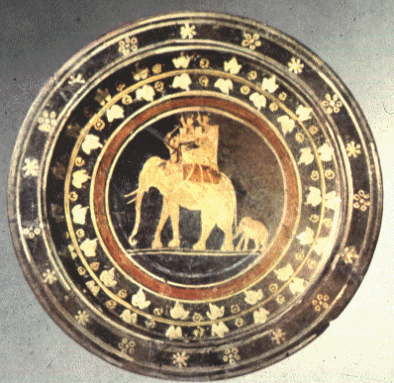
Hannibals's Elephants

Hannibal's Campaign Against Rome

In 218 BC, Hannibal from Carthage (near modern Tunis) crossed over the Alps and attacked Rome. The Roman army was surprised. They did not expect any enemy to cross frozen Alpine ranges and attack them.

And after the surprise, came the terror. Hannibal brought in elephants with his army. Terrorized Romans had no experience against elephants - and no answer either. And how many elephants did Hannibal have?

Hannibal started with 37 elephants. By the time he crossed the Alps, twenty were left. By the time he reached the outskirts of Rome, he was left with just one - Surus.

But, Rome never overcame the surprise of Hannibal's attack or the terror of elephants. Over the next few years, Hannibal defeated the Roman army in a number of battles. Hannibal's allies were the Numidians and other African rulers. For the last 2000 years, Western historians have written reams on Hannibal's campaign - and his elephants.

Recently, (from 1994-2006) a Stanford University team worked on tracing Hannibal's Alpine Route. During the 12 years, they asked all the questions - except the really important ones.

Where Did Hannibal Get The Elephant Idea From

Plutarch narrates that Hannibal had a high opinion of Pyrrhus - and it is speculated that he may have read Pyrrhus' manual on generalship.

Pyrrhus (of Epirus and Macedon), Alexander's cousin, used 20 elephants c.280 BC against the Romans. And won a 'pyrrhic' victory. Another case of terror inspired by elephants.

Of course, Pausanias, let the cat out of the bag. He says:

"... being perfectly aware that he (Pyrrhus) was no match for the Romans, he prepared to let loose against them his elephants. The first European to acquire elephants was Alexander, after subduing Porus and the power of the Indians; after his death others of the kings got them but Antigonus more than any; Pyrrhus captured his beasts in the battle with Demetrius. When on this occasion they came in sight the Romans were seized with panic, and did not believe they were animals. [1.12.4] For although the use of ivory in arts and crafts all men obviously have known from of old, the actual beasts, before the Macedonians crossed into Asia, nobody had seen at all except the Indians themselves, the Libyans, and their neighbours."

Elephant stories - from The Rest Of The World

The interesting story of Ptolemy's elephants comes from another Greek 'historian' Polybius in Raphia (book V) ...

few only of Ptolemy's elephants ventured to close with those of the enemy, and now the men in the towers on the back of these beasts made a gallant fight of it, striking with their pikes at close quarters and wounding each other, while the elephants themselves fought still better, putting forth their whole strength and meeting forehead to forehead. The way in which these animals fight is as follows. With their tusks firmly interlocked they shove with all their might, each trying to force the other to give ground, until the one who proves strongest pushes aside the other's trunk, and then, when he has once made him turn and has him in the flank, he gores him with his tusks as a bull does with his horns. Most of Ptolemy's elephants, however, declined the combat, as is the habit of African elephants; for unable to stand the smell and the trumpeting of the Indian elephants, and terrified, I suppose, also by their great size and strength, they at once turn tail and take to flight before they get near them.

Two things we know - which Polybius did not.

One - the African elephant is larger than the Indian elephant - not smaller. Two - African elephants have never been been tamed in large enough numbers to be used in wars. In the rare instances, where African elephants have been trained, it has seen the involvement of Indians - both Indian trainers and Indian elephants. But more on that later ...

Indian elephants in battle history

In the battle against the Massagetae, resulting in the defeat and death of Cyrus, against Queen Tomyris, Indian elephants played a crucial role. Thereafter, Persians (then Zoroastrians) did not use elephants for a long time (considered evil by Zoroastrians). Possibly, the outcome against Alexander would have been different, had they used more elephants at Gaugamela - instead of 12-15.

The story of Semiramis the Assyrian Queen and the Indian King Stabrobates by a Greek 'historian,' Ctesias (in Diodorus Siculus) is of interest. Apparently, foreign armies used 'faux' elephants to frighten enemies.

One of Alexander's generals, Seleucus Nicator traded in some part of his empire, for 500 elephants. After Alexander's death, in the ensuing Diadochi wars, at the decisive battle of Ipsus, the Indian elephant unit won back a larger territory for Seleucus than what he had ceded to Chandragupta for obtaining them. It was the Indian elephant unit, that was "largely responsible for the victory which netted him (Seleucos) the province of Asia".

At Ipsus, the Seleucid army fielded "the largest number of elephants ever to appear on a Hellenistic battlefield" which turned out to be, as a historian describes as the "greatest achievement of war elephants in Hellenistic military history." And Pyrrhus learnt his lessons, on using elephants, during the Diadochi wars, at the decisive battle of Ipsus - where it was the Indian elephants that gave Seleucus a victory.

Battlefield value of elephants

If the Roman armies could be frightened by twenty of Pyrrhus' elephants, or Hannibal's thirty seven, these war elephants did have significant military value.

Again, if Roman armies could be frightened by 20 elephants of Pyrrhus, or Hannibal's 37, what happened to Alexander when faced with 100s, if not 1000s of elephants, which were common in Indian armies. To put that in perspective, Chandragupta Maurya had thousands - figures range between 5,000 to 9,000. And how many elephants did Porus’ army have? 200 elephants is the estimate, by Greek hagiographers.

So, if elephants were so valuable, why did elephant training not take root in other countries? Why were elephant trainers not encouraged? Where did the elephant trainers of Pyrrhus and Hannibal disappear after 100 BC?

Seleucus did set up a centre for elephant training at Apamea, a city named after his Bactrian wife, Apama, manned by Indians. And actually, having learnt their lessons, the Romans, in 163 BC, sent a contingent into Laodicea, Syria, to neutralize this elephant unit and destroy Seleucid navy.

Again there are inconsistent reports about the search for war elephants by the Greek Ptolemy rulers of Egypt. Ptolemy-I banned the killing of elephants. Ptolemy-II Philadelphus, then supposedly recruited 300 African elephants from modern day Somalia, Eritrea, Sudan and Ethiopia - which were delivered to him by the Kushites (Ethiopians).

Supposedly, the Kushites had tamed elephants - though not for war purposes. Apart from the few Kushite elephant riders, Ptolemy II sent special envoys to India to recruit elephant riders. These ill trained elephants and their riders were singularly unsuccessful against the Indian elephants (in the Selecucid army) at Raphia (Polybius in Raphia (book V).

Probably the figure of 300 elephants in Ptolemy's army was inflated for disinformation purposes. The Kushites did not (possibly) deliver African (usually, larger) elephants, but switched these with small Asian elephants. These smaller animals were probably rejects, going at a discount, from other professional Indian elephant trainers.

Two things that Ptolemy (possibly) did not know - One, elephants (Indian or African) cannot truly be 'tamed.' Two, elephants can only be taught to trust and do 'favors' for specific elephant trainers. Individual elephants form a life long link with individual trainers.

Alexander - Hagiography and /or Cultural Dacoity?

The mythos surrounding Alexander calls for serious questioning of the sources themselves. What and who are these sources?

Our knowledge of Alexander therefore rests on histories produced long after the fact: a late first-century b.c.e. section of a world history written in Greek by Diodorus of Sicily; a Latin History of Alexander published by the Roman author Quintus Curtius Rufus in the first century c.e.; a biography in Greek by Plutarch of Chaeronea, also produced in the first century c.e.; a history written in Greek by Arrian of Nicomedia sometime in the second century c.e.; and Justin's third-century c.e. Latin abridgment (Epitome) of a lost Greek secondary account by the first-century author Pompeius Trogus. Each of these five narrative treatments of Alexander's reign claims to be a serious work of history or biography, but all five contradict one another on fundamental matters and cannot be considered absolutely reliable unless somehow corroborated by other evidence. Beyond these texts, we have little except a compilation of legendary material known as the Greek Alexander Romance, a wildly imaginative work filled with talking trees and other wonders that later thrilled the medieval world. (from Alexander the Great and the Mystery of the Elephant Medallions By Frank Lee Holt).

This is the foundation on which Westerners have based their version of Indian history. 400 years after Alexander's death, Arrian's hagiography is today seen by the Western world as the last word on Alexander. One man's word as history? This version of history alleges that Alexander conquered India by defeating King Porus. Western historians cannot see the contradiction between a 'disunited' India with more than a 100 kings - is suddenly 'felled' due to the defeat of one King Porus?

Alexander's 'boasts' about his conquest of India, a super-power then, did get him mileage. Subsequent to his Indian 'conquest' Alexander minted elephant coins - which modern Western historians ascribe to his conquest of 'India' by winning against Porus.

The significance of these coins itself is questionable. Elephant units, managed by Indians, were a common feature in Central Asian region - and later Greek armies also co-opted elephant units. These elephant coins could well have been stuck to celebrate Alexander's victory at Gaugamela over Darius. Elephant coins were also issued by Ptolemy, to lend legitimacy to his rule, showing Alexander wearing an elephant head looking like a mixed Zeus and Ammon.

It also became the butt of comedies. These Greek comedies survive through Roman writers like Plautus' Curculio - with an ex-India soldier, Therapontigonus Platagidorus, who boasts of his conquest of

the Persians, Paphlagonians, Sinopians, Arabs, Carians, Cretans, Syrians, Rhodes and Lycia, Gobbleollia and Guzzleania, Centaurbattaglia and Onenipplearmia, the whole coast of Libya and the whole of Grapejusqueezia, in fact, a good half of all the nations on earth, have been subdued by him single-handed inside of twenty days

and wants a golden statue - made with melted gold from Philip (of Macedon's) gold coins. Other such unbelievable accounts were written in Greece and Rome about Alexander's victory against Porus - "a popular subject in Greece and Rome for many centuruies."

Tired soldiers? More like frightened ...

Indian archaeology, writers and history do not know of any Porus - or Alexander. Why did Alexander's undefeated troops, after the Indian campaign, suddenly feel homesick?

What possibly frightened Alexander's army was the 'information' that further lay places

"where there were elephants in yet greater abundance and men were superior in stature and courage

As per Arrian, the only 'victory' celebration by Alexander's troops was after the battle with Porus. Surprising - that Alexander's troops did not celebrate any victory, till the very end of the campaign.

Was it instead, a celebration of their 'Great Escape' from India - with their lives?

During the (nearly) half-year long siege of Tyre, Alexander's 'tired' soldiers' were reinforced by fresh troops reinforcements from Macedonia. Before his India 'campaign', Alexander cashiered thousands of his Greek troops, at Ecbatana, who wished to return home. After the death of Darius, at Ecbatana (330 BC), to all the Greek officers, wishing to return home, Alexander awarded one talent of gold (approx. 25k-60 kg).

Also at Ecbatana, Alexander dismissed the allied Greek troops he had requisitioned thus far under the powers granted him by the Greek league. The official gaol of the invasion, the destruction of the Persian empire in revenge for its attack on Greece, had now been achieved, so the official duties of these troops were fulfilled. (from Alexander the Great By Arrian, James S. Romm, Pamela Mensch)

At this stage, Alexander also inducted into his army, fresh Persian soldiers, trained in Macedonian style of warfare. Again, after his marriage to Roxanne, 10,000 Persian soldiers joined his army.

Hence, the troops left were either fresh or those who decided to stay with Alexander. 326 BC was the year of the battle with Porus. The pleadings of Coenus, that Alexander's men, "long to see their parents, wives, and children, and their homeland again." were patently the cries of frightened soldiers.

Once back in the folds of the secure Macedonian Empire, the same 'tired' soldiers, joined the mutiny at Opis and revolted when they were released by Alexander to return to Macedonia, demonstrates that reason for the revolt in India, was not home sickness.

Consider

Amongst Alexander's first actions in India were his attempts to cobble up alliances. His most famous one was with Ambhi - the ruler of Taxila. In India, Alexander had to pay the King of Taxiles, Omphis, (Ambi) 1000 talents of gold (more than 25 tons of gold) - to secure an alliance. To cement this alliance, Alexander 'gifted' Ambhi with 'a wardrobe of Persian robes, gold and silver ornaments, and 30 horses, 1000 talents in cash'. 1000 talents is anywhere between 25,000-60,000 kg of gold! Does this look like Ambhi accepted Alexander as the conqueror of the world - or Alexander 'persuading' Ambhi to seal an alliance?

The payment of 1000 talents in gold to Ambhi aroused much envy and outrage in Alexander's camp. It prompted Meleager, to sarcastically congratulate Alexander for 'having at least found in India a man worth 1000 talents.' What seals this incident is Alexander's retort to Meleager, "that envious men only torment themselves." (C 8.12.17 & 18).

He had to return the territory of Punjab to Porus - purportedly, after winning the battle. The lean pickings and small loot from India provoked a vicious response from Alexander - “the Macedonians frequently massacred the defenders of the city, especially in India.”

As Alexander retreated from India, a Mallian force attacked the Macedonian army. In this Mallian attack, Alexander was himself injured - and his very life was in balance for the next many weeks. Greek writers wax about Alexander's grief at the death of his horse, Bucephalus during the Indian campaign.

Ekkehard, a 12 century Benedictine monk, a participant in the Crusade of 1101, had many such questions, in his updates of Chronicon Universale, (probably co-written by Frutolf of Michelsberg).

Coming so soon after the schism between the Greek and the Roman Church, Ekkehard must also be seen through the prism of Christian Church politics. After all, how could a monk of the Roman Church let go of such a juicy Greek target? Similarly, in 19th century environment, Alexander's inflation must also be seen in the context of Western colonialism, which needed to show 'Western' superiority.

After Alexander

By 303 BC, less than a 20 years after Alexander's death (323 BC), Alexander's greatest general, Seleucos Nicator, sued for peace with Chandragupta Maurya. Megasthenes was Seleucos' Greek ambassador at the Indian court. Megasthenes' account of India (which, allegedly does not exist) was widely quoted by other Greek historians. His account of elephant capture using decoy female elephants was (presumably) known in Greece.

So, where did Hannibal and Pyrrhus get their elephants from? Elephants obviously cannot be transported over sea - cooped in a cage for weeks or months. This is assuming that cages and holds could have been made strong enough to hold an elephant for 2 weeks to 2 months - 2000 years ago.

The Only Country That Tamed Elephants

The only country in the world to use elephants, significantly, in peace and war were Indians - for more than nearly 5000 years. Alexander's turning back at Indian borders was symptomatic of the fear that Indian elephants evoked in the rest of the world.

The use of elephants was significant only to Indians. In most of China, elephants became rare by 300 BC. Although the South Han dynasty maintained a small elephant unit in their army, Chinese were never significant users of elephants in armies.

Elephant capture (khedda), training, manuals and terminology originate in India. Elephant riders (mahavats), elephant chairs (howdahs) and elephants in heat (masth) are all Indian terms. From India, elephant management skills, in a limited manner spread, to Sri Lanka, Thailand, Cambodia and other parts of South East Asia.

Elephant Training

So, who was riding Hannibal's elephants? Did Hannibal and Pyrrhus create an elephant training school, get the right recruits, identify the right species, capture wild elephants, tame these wild elephants and induct these elephants into their armies in a short space of a 3-7 years? For a single campaign?

Unlike horses, elephants can't be 'broken' or 'tamed.' They cannot also be trained to trust 'human beings' as a species - like horses can be trained. In India, elephants have been managed, by skills garnered and conveyed over centuries, for generations, within a small specialized community. The English word, elephant is derived from Sanskrit word for ivory (ibha+danta = elephant+teeth).

Unlike horses, elephants can be 'ridden' only by specific individuals. Each elephant has a specific 'rider(s)' - and mahavats are not interchangeable. Elephants trust individual mahavats - and this relationship is nurtured for the life time of an elephant.

Did Hannibal and Pyrrhus, create a team of elephant trainers for just a few years? Where were these elephant trainers themselves trained? Where did these trainers subsequently disappear? Since, elephants were such a valuable military advantage, why did Hannibal's and Pyrrhus' elephant managers disappear? Why were these skills not transferred considering the obvious commercial value?

African ... Libyan ... Syrian ... decide

Hannibal's allies were the Numidians (now known as Libyans) and other African rulers. Facilely, Western historians claim that Hannibal used African elephants. We also know that African elephants (even today) are difficult to train. There is the legless theory, that extinct Mesopotamian-Libyan-Syrian breed of elephants, the Elephas maximus asurus, were used, is based on pure speculation. Resting in air, without any archaeological, written, oral, history evidence,

The so-called 'Syrian elephant' has been seen by some as a distinct species of the Asian elephant (i.e. E.maximus assurus). However, this identification rests on dubious rounds, namely tusk shape and representations of the animal, e.g. (in the Theban Tomb of Rekhmira, the vizier of Thutmose III (TT100, see below). Osteological work has been limited, but molars found at Ugarit suggest that the elephant of the western Asia was was identical to the living species (E.maximus). (from Ancient Egyptian Materials and Technology By Paul T. Nicholson, Ian Shaw).

These Syrian were possibly Indian elephants, obtained by Syrian kings, Seleucus I and Antiochus III - at a high costs. Did this 'Syrian' elephant breed, supposedly became extinct, promptly and conveniently, after winning battles and wars, for Pyrrhus and Hannibal around 100 BC?

Another case of a lazy historian, was

paper by John Mathew of the Department of History of Science, Harvard University, in my lap. His paper, titled ‘Nichola Poussin and the vexatious case of the elephants of Hannibal’, wonders why Hannibal chose several Asian elephants for his campaign, including his own Surus. Mathew’s interest in the subject was kindled on seeing a famous painting, from the 1620s, in Harvard’s Fogg Museum. The painting, titled Hannibal Crossing the Alps, was done by a French artist, Nicolas Poussin, and shows Hannibal on an Asian elephant during that epic march.

The reason, Mr.Matthew, why it is Asian elephants (and specifically Indian elephants), is that war elephants is not everyone’s game. It was a game that only Indians knew how to play! Maybe you (Mr.Matthew) don't like the answer, but sometimes there are inconvenient answers. Is it the fear, that this answer, may raise many more questions, which possibly stops you from giving the correct answer?

The Riddle & The Answers ...

Question: Quick! What is common between Western (Eurocentric) history and Swiss cheese?

Answer: Easy! They are both full of full of holes.

The simple answer is, Indians (from the sub-continent) or the Hittite stragglers, from the armies and kingdoms of Indo-Aryan Elamite-Hittite-Mittani rulers. The probable source of the Latin word for elephant , luca bos is also derived from the Hittite word, luhabos, meaning ivory. The modern word elephant, is also possibly derived Indic words, ibha+danta - meaning elephant teeth.

These Indians were in Europe with Hannibal and Pyrrhus. Either fighting these battles (as mercenaries) or as elephant riders or training an (improbable) second line of Greek elephant riders. Polybius does mention that it was the Indoi that were riding these elephants - but modern historians take considerable pain to deny this.

The Stanford University has approved a project to work on tracing Hannibal's Alpine Route. During the 12 years, they asked all the questions - except the really important ones. Another, John Hoyte, British engineering student decided to trace the Alpine route on an elephant - an Indian elephant, called Jumbo, borrowed from the Turin Zoo. Maybe, these questions would be answered if this trek was done on African elephants - clearer answers!

The only country which has a 5000 year history with elephants is India - from Indus Valley to date. In peace and in war. But, Western historians tie themselves in knots denying the Indian connection.

And that strengthens the 'intellectual export' from India to Europe theory rather than the 'Greek miracle' story.