Showing posts with label Software. Show all posts

Saturday, June 6, 2009

Namaskarah World ...

Behind how people greet each other is the story of how cultures and people view each other. The two most common forms of greeting people in India are namaskaar नमस्कार and touching feet, दंडवत, dandavat.

Namaskaar is done from a distance, by joining both hands and a slight inclination of the head. Touching feet, दंडवत, dandavat, is the other greeting, reserved for elders and seniors, by juniors. This form of greeting is done by bending down from the waist and touching the feet of the opposite person. Sometimes as a mark of greater respect, the bending is done at the knees also, with the knees touching the ground. An extreme form of this greeting is lying on the ground, chest down and touching the feet.

These greeting styles are common all over Asia - East of India. Joining hands at chest level is also prevalent in the West as a form of prayer - but not as greeting. Both these Indian styles are unique in the culture of the world - for two reasons. But before that let us examine the other two forms of greetings that are popular and prevalent in the world.

From the Desert Bloc - shalom, salaam and the handshake

Done at close quarters, within touching distance, one hand is always kept free and disengaged. What if the 'enemy' attacks?

The other form of greeting is the common Islamic form of greeting - touching one's own forehead with the fingertips of the right hand. This greeting is also done from distance.

Hidden hands ... hidden intentions

These greeting forms underline the mode of social interaction. The 'hidden' hand in the shalom /salaam /handshake signify the 'preparedness' for 'treachery', 'betrayal' or 'perfidy'. 'Namaskaar' and 'dandavat' signify clean and empty hands - signifying openness and trust.

Empty hands vs. 'hidden' hands

This difference in values requires a drastic re-interpretation of 'negotiation' and 'transaction' methodology - in business, diplomacy and at an international levels.
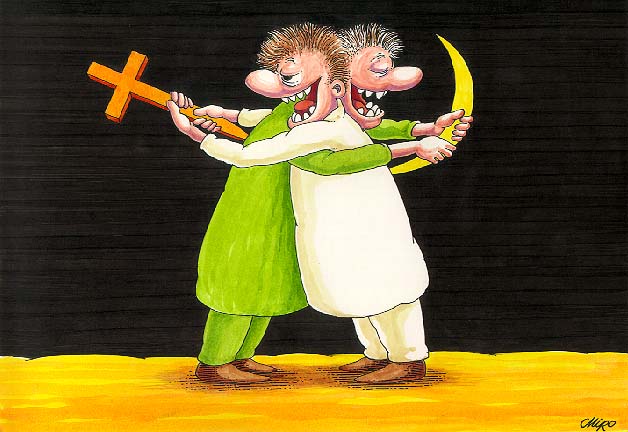
At one end of the spectrum, the response is best illustrated by Shivaji in his 'negotiation' with Afzal Khan. Using a concealed weapon, he used the meeting to kill Afzal Khan.

In more modern and relevant context, are the WTO and trade 'negotiations' and 'disputes', where at stage after stage, the West has come with 'hidden' agendas and weapons.

Saturday, December 15, 2007

Indian Software Success - How Come?

A 35 year old Indian advertising executive (with a short London based, work-experience at Car Phone Warehouse) had an interesting observation.

There is a transfer effect! We Indians, get respect in some parts of the world today, because we are Indians. Earlier perception of Indians was based on the individual. Indians were not respected for their nationality. Now, Indians gets some respect because they are Indian.

How Did This Happen

And the Indian image makeover was due to the work done by the software guys on the Y2K problem. The Y2K was a major disaster - waiting to happen! The world waited with bated breath - for planes to crash; banks feared billion dollar frauds; defence systems would blink. But, on Y2k, nothing happened. The world over!

It just another day. It was the biggest triumph for the Indian software community. Done at a cost of a few billion dollars. The Y2K meteor did not crash onto mother earth - it burnt at the time of entry in the earth’s atmosphere. As usual Indians do not celebrate their major successes. (Instead they make a big deal of the 20:20 world cup)

India’s software success has many claimants - and all of them have had a role to play. And in this crush, one small thing escaped everybody’s notice.

Why Did Software Become Such A Big Thing

Why is it that software became such a big thing in India? How come Indian engineers with such low levels of prior exposure to computers could ramp up so quickly and tackle such a complex problem? How could a country with the lowest computer penetration become the largest expeorter of software in less than 10 years.

The answer goes back to 5000 years ago.

When Sanskrit language was invented. Yes. Invented.

What!! What Has Sanskrit Got To Do With This

Sanskrit is an artificial, synthetic, revolutionary language - unlike all other languages in the world; which are Prakrit (natural and evolutionary). The next set of artificial languages came into this world after 5000 years later.

About 50-75 years ago, the next set of artificial languages were invented. These are the computer languages. Between the invention of Sanskrit and the computer languages , there was no other culture which created an artificial language system.

What is special about Sanskrit?

Sanskrit is nothing but a database system with millions of database tables and a system of linking concatenated data records. And all Indian languages are derived from Sanskrit.

While most of us do not know Sanskrit or understand it’s structure consciously, we all use Sanskritic structures everyday. It is easy for us to learn another “Sanskritic” language! Hence, for all those brilliant engineers, their base in Sanskritic languages gave them a headstart.

And the rest as they is history!