The importance of Takshashila
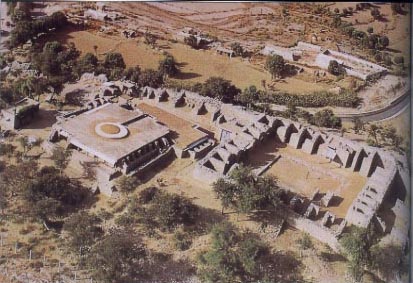
As the oldest university in the world, Takshashila has a special place in the history of the world. More so, in Indian history. It's destruction (purportedly) at the hands of the
Hunas, as proposed by Western historians (and their followers) has been rather facile - to say the least.
There is evidence that the truth may be otherwise. This post lays out an alternative scenario, but before let us refresh ourselves with the history of Takshashila.
Takshashila in classical texts, history, geography
The Vayu Purana traces the start of Takshashila, to Taksha, son of Bharata (brother of Raghu Ram Chandra). Takshashila also finds a mention in Mahabharata - citing Dhaumya, as the acharya of Takshashila. It was at Takshashila, that Vaishampayana made the first recorded narration of the Mahabharata to Janmajeya.
 It finds continued mentions in numerous Jatakas, too. For centuries, across many cultures, stories of Takshashila (and its environs) swirled, like even later,
According to a story contained in the Mujma-t-Tawarikh a twelfth-century Persian translation from the Arabic version of a lost Sanskrit work, thirty thousand Brahmans with their families and retinue had in ancient times been collected from all over India and had been setttled in Sindh (from Al-Hind, the Making of the Indo-Islamic World By André Wink).
The Buddhist anthology of stories, Avadana-shataka mentions that "3.510 millions of stupas were erected at the request of the people of Taxila".
Students paid 1000 coins in advance to receive education at Takshashila - and there were thousands of such students. Students came from all over the world – and paid large sums of money to Indian teachers for education! Kings, brahmans, commoners - all came to study at Takshashila. Its alumni included all the stars of the Indian firmament - Atreya, Pasenadi, Mahali, Patanajali, Jivaka, Panini, Kautilaya, Prasenjita.
Its development and importance lay in the fact that,
Takshashila and Purushpura on either side of the Sindhu river were connected with the Indian trade routes on the Indian side and Central Asian trade routes on the other. Strategically located, Takshashila, the capital of Gandhar, was the terminus of several inland routes and the starting points of the great trade routes connecting India and Central Asia. (from India and Central Asia By J. N. Roy, Braja Bihārī Kumāra, Astha Bharati (Organization)).
Based on subsequent excavation and diggings, it is thought that Takshashila was the oldest city in South Asia - when Alexander landed there. So Takshashila's historic and cultural importance is too high to become a victim of slip shod colonial propaganda - posing as history.
Chinese travellers to India
 An important source for 'modern' history, much used by Western historians are the travels of Chinese travellers (like Fa Hian/ Faxain, Huien Tsang /XuanZang). Supposedly 1000 years after death of Gautama Buddha, overlooking some gaping holes in Fa Hian's travelogue.
How could Fa Hien miss meeting /mentioning Kalidasa - supposedly a contemporary of Fa Hien? In fact, Kalidasa is not mentioned at all in Fa Hian's account, which supports the hypotheses that Kalidasa preceded Fa Hian. It may be pointed out that since, Kalidasa's works are artistic rather than religious or philosophical, the lack of Fa Hain's interest in his works is obvious. But to ignore a man of Kalidasa's stature and learning?
Then Fa Hian misses the name of the supposed ruling 'Gupta' king - a dynasty which ruled over most of South Asia! And it is Fa Hian who is supposedly a significant authority on the Gupta period. Western history labelled the Gupta period as the 'golden age' of Indian history - which Fa Hian seems to have completely missed. Similarly when Fa-Hien visited Takshashila in 5th century AD (travelled in India during 399-414 AD), he found nothing. His travelogue makes some cursory mentions of Takshashila.
And that leaves Indian history with some rather big 'dating' holes! Is it that Fa hian visited India much after Kalidasa, the Gupta dynasty, the death of Buddha? Maybe a few centuries later, relative to the period in Indian history. Fa Hian's date is well indexed. So that possibly cannot move much. It is the the corresponding Indic dates which come into question!
Another Chinese traveller, Sung Yun, who had a rather exalted view of his country and its ruler, is largely responsible for overly negative image of the Hunas in 'modern' history. Sung-Yun's peeve - the Huna king did not read the letter from the Wei Tartar king standing, but in a seated position. A modern historian writing on the spread of Buddhism and Buddhist traveller's tales thinks that,
Like most things India it (Buddhism) suffered somewhat from the invasions of the Huns, who dominated many parts of the northwest from 480 to 530; but the immediate effect of their depredations does not seem to have been very striking. At any rate, the Chinese pilgrim Sung Yun, who travelled through this region in 518-21, gives us a picture in which Buddhism is quite as thriving as it was in Fa-Hien's time. (from The Pilgrimage of Buddhism and a Buddhist Pilgrimage By James Bissett Pratt, page 111).
Subsequent Chinese travellers to India like I Ching (I Ching or Yi Jing, Yìjìng, Yiqing, I-Tsing or YiChing), were more about Buddhism the religion that it had become, instead of a school of learning and thought. I Ching also recorded details of the works and life of Bhartrhari, the (probably) 5th century grammarian and poet. His take away from India, from Nalanda "in ten years (A.D. 675-685), during which he collected there some 400 Sanskrit texts amounting to 500,000 slokas."
The 'end' of Takshashila
 The colonial narrative of traces the destruction of Takshashila in 499 AD, by the Hunas (Western history calls them White Huns, Romans called them Ephtalites; Arabs called them the Haytal; The Chinese Ye Tha). Western 'historians' have ascribed the demise of Taxila to the White Huns, a Central Asian, nomadic tribe, roaming between Tibet to Tashkent, practicing polyandry.
Takshashila lying at the cross roads of the Uttarapatha (West calls it The Silk Route) – from Tibet, China, Central Asia, Iran – and India, fell to this mindless savagery, goes the 'modern' narrative. But specifically, there is no mention in Chinese, Persian, Indian texts (that I could find) of the Hunas who destroyed Takshashila. So, how and where did this story spring from?
Kanishka, a major Buddhist king, was a Yue Chi, known as Tusharas in India, related to the White Huns. Why would his tribal cousins destroy Takshashila?
History as propaganda
 We have the 'imaginative genius' of Sir John Marshall to thank for this - a man who was "interested in Alexander's campaign and in Graeco Buddhist monuments at Sanchi and Taxila." Sir John, who was "filled with enthusiasm for anything Greek" was also aware that it was at "Taxila that Alexander the Great halted and refreshed his army before advancing to do battle with Porus." Not one to stoop below self-aggrandisement, he is among the "few archaeologists now living who have devoted as many years to the excavation of a single site as I have devoted to Taxila." He lays out the ground for the 'destroyer White Huns' theory, describing how
the hordes of Ephthalites or White Huns which swept over Gandhara and the Panjab in the third quarter of the fifth century, carrying ruin and desolation wherever they went. (from Taxila - an illustrated account of archaeological excavations By Sir John Marshall page 76).
And his evidence for this destruction is,
Thirty two coins, all of them silver, leave no room for doubt it was it was the White Huns who were responsible for the wholesale destruction of the Buddhist sangharamas of Taxila ... several skeletons of those who fell in the fight, including one of White Hun, were lying. (ellipsis mine; from Taxila by Sir John Marshall page 791).
Join the gang!
A chorus of historians joined in Sir John's smear campaign (published between 1940-1951) against the White Huns who were 'guilty' of 'destruction of Takshashila'. Sir John lays the burden of guilt at the doorstep of the Hunas (Western history calls them White Huns, Romans called them Ephtalites; Arabs called them the Haytal; The Chinese Ye Tha). Based on traveller's tall tales, we have 'modern' historians who have depicted, without any evidence, that the
the White Huns, or Hephtalites, felt a kind of hatred toward Buddhism and strove to destroy all its physical as well as mental manifestations during the fifth century. This is how Taxila brutally vanished. (from Books on fire: the destruction of libraries throughout history By Lucien X. Polastron, Jon Graham page 107-108).
And this is from a book which claims to be a "historical survey of the destruction of knowledge from ancient Babylon and China to modern times". Another book seeking to capture Central Asian history writes that these Hunas, who came,
sacking monasteries and works of art, and ruining the fine Greco-Buddhic civilization which by then was five centuries old. Persian and Chinese texts agree in their descriptions of the tyranny and vandalism of this horde.” (from The Empire of the Steppes By Rene Grousset, Naomi Walford).
It has been pointed out that
Although the exact relationship between the Buddhist communities of the Peshawar basin and the new Hun dynasty is not entirely clear, there is considerable evidence to suggest that Buddhism continued under Hun rule ... (there is) textual evidence to show that Chinese Buddhist pilgrims continued to visit Gandharan sites in the Peshawarn Basin into the early sixth century C.E.; The Bhamala main stupa can be compared to the 7th to 8th century cruciform stupas in Kashmir, Afghanistan, and other parts of Central Asia. (from The Buddhist architecture of Gandhāra By Kurt A. Behrendt pages 207-209).
Technically, it was also pointed out that Sir John did not stratify his digs, which creates a dating and sequencing problem. Going with self-aggrandizing nature, Sir John also focussed on 'glamourous digs' - without focussing on the connectivity issues.
Alexander in colonial historical narrative
 For more on the decline of Takshashila, it is Alexander that we must turn to.
Alexander has long been a vital cog in Western colonial narrative of history. Alexander’s halo gave bragging rights – first to the Greco-Romans and then to the Euro-colonialists.
The American Department of Defense, in its Legacy Program, has a section on Cultural Heritage Training. The use of Alexander’s mythos there is self evident. Between the Greco-Roman historians and the Euro-Colonialists, has sprung an entire industry, to create a mythos surrounding Alexander.
Amongst Alexander’s first actions in India were his attempts to cobble up alliances. His most famous one was with Ambhi – the ruler of Taxila. In India, Alexander had to pay the King of Taxiles, Omphis, (Ambi) 1000 talents of gold (more than 25 tons of gold) – to secure an alliance. To cement this alliance, Alexander ‘gifted’ Ambhi with ‘a wardrobe of Persian robes, gold and silver ornaments, and 30 horses, 1000 talents in cash’. 1000 talents is anywhere between 25,000-60,000 kg of gold! Does this look like Ambhi accepted Alexander as the conqueror of the world – or Alexander ‘persuading’ Ambhi to seal an alliance?
The payment of 1000 talents in gold to Ambhi aroused much envy and outrage in Alexander’s camp. It prompted Meleager, to sarcastically congratulate Alexander for ‘having at least found in India a man worth 1000 talents.’ What seals this incident is Alexander’s retort to Meleager, “that envious men only torment themselves.” (C 8.12.17 & 18).
Black and blue
Instead of the complete capitulation and collaboration that Alexander got from the defeated Achaemenid ruling family of Sisygambis, Stateira, Oxathres (brother of Darius III; also written as oxoathres and oxyathres) et al, the foursome of Bessos, Spitamenes, Datafernes and the Scythians made Alexander’s life miserable. At Gaugamela, it was Bessos and his Indian cavalry, which broke Alexander’s formations. As a 19th century historian reports,
During the three years anterior to the passage of the Indus, Balk (Bactria) was usually Alexander's headquarters. It was in these countries that he experienced his only serious reverses in the field. (from On the practicability of an invasion of British India By Sir George De Lacy Evans).
The tribes and kshatrapas (satraps) of Indian North West swath, delayed Alexander for nearly three years – before he could step into India. In India, Alexander had to pay the King of Taxiles, Omphis, (Ambi) 1000 talents of gold (more than 25 tons of gold) – to secure an alliance. He had to return the kingdom of Punjab to Porus – purportedly, after winning the battle. His loot and pickings from India were negligible.
To these lean pickings, Alexander’s reaction – “the Macedonians frequently massacred the defenders of the city, especially in India.” What was Alexander's response to a ‘sub-continent occupied by a complex network of peoples and states, who viewed Alexander as a new piece to be played in their complex political chess game.' Another modern historian, an expert on Greek history writes that 'the tale of slaughter told in the ancient sources is unparalleled elsewhere in the campaign.' ( from Ancient Greece By Sarah B. Pomeroy, Stanley M. Burstein, Walter Donlan).
The Indian reaction
Alexander's massacres in India, a colonial historian informs us (without naming a source), earned him an "epithet ... assigned (to) him by the Brahmins of India, The Mighty Murderer." This Indian Brahmanic characterization of Alexander, commonly taught to English schoolchildren and present in Eglish college texts, as The Mighty Murderer, curiously disappeared from Western-English texts soon after 1860 - and instead now "a positive rose-tinted aura surrounds Alexander" ... !
Greek writers report, that Alexander finally realized that it was the Indian Brahmins who had influenced Indian princes to organize and support the Indian war against Alexander. Greek sources cite, after this realization, at ‘The City of Brahmans’, Alexander massacred an estimated 8000-10,000 of these non-combatant Brahmans. His question-answer sessions with the 10 Indian-prisoners-Brahmans (called Gymnosophists by the Greeks), related by Plutarch, shows Alexander at sea, completely lost.
And arising from this frustration, came Alexander's wanton massacres at Takshashila - which thereafter limped along for the next 1000 years, but never to fully recover.
More questions on the destruction of Takshashila
At the time of Takshashila's decline in the 5th century, a significant Gupta king was Purugupta - successor of Skandagupta. Written records from Purugupta's reign are few and far in between, he has been variously named as Vikramaditya, Prakashaditya and of course as Puru /Pura Gupta.
The most authentic link to his reign is the Bhitari seal inscription, (near Ghazipur, in modern UP). The Bhitari seal provided proof of an elongated Gupta reign - than the Skandagupta-was-the-end-of-Gupta dynasty dating. Currently dated between 467 AD, Purugupta's reign saw many border wars.
Purugupta's reign saw Vasubandhu, a known teacher of logic and debate, become famous and Huien Tsang reported on the debates based on Vasubandhu's texts. Today Vasubandhu's texts exist in Chinese and Tibetan languages - the original Sanskrit volumes remain untraceable. Purugupta also restored the gold grammage in the ‘suvarna' coins, probably debased in Skandagupta's time, possibly due to the cost of the fighting the Hunas.
Is it that the Porus identified by the Greeks, Purugupta? Were the marauding soldiers, mentioned in Chinese texts, mercenary soldiers hired by Alexander to replace the 'deserting Greek' soldiers, on the eve of his Indian 'campaign'? The dating of the Gupta dynasty to end of the 5th century AD, is probably off by about 800 years.
The Indian defence system
Taksashila's destruction raises an obvious question! And also important. What did Indian polity do to defend centres of excellence like Takshashila?
To protect such a vibrant and important centre of leaning, the Indian polity had evolved a complex structure across the entire North Western swath. Thus while, within the Indic area, borders and crowns kept changing and shifting, invaders were kept at bay. A system of alliances supporting frontline kingdoms in the entire North West Indian swath was formulated.
For instance, against the Assyrian invasion, led by Semiramis, a minor Indian king, Stabrobates, was supported to beat back the Assyrian invasion. Against Cyrus the Great, Tomyris, a Scythian Queen was supported to massacre Persian invaders. Alexander’s nightmare began immediately, as soon as he crossed from the Persian area into the area governed by the Medes - an Indic area.
A symbol of these alliances, for instance, was the House of Suren’s traditional rights to install the crown of Persian rulers. Some ancient maps show the Gandhara-Takshashila region as Suren. And it was at the hands of these very Surens that Crassus met his nemessis. At the hands of the Indo-Parthian armies - led by a Suren general.
The Sassanian dynasty was able to wrest back and defend Persian dominions from the Greco-Romans, after setting up an elephants corps in their army – evidenced, for instance, by the carvings at Taq-i-Bustan. At one time, the Sassanian rulers had increased its elephant corps to 12,000 elephants.
End of Crassus
 Less than 300 years after Alexander, Romans came close to Indian border. They were led by Marcus Licinius Crassus – estimated (or allegedly) worth 200,000,000 sestertii. A writer of classical journals estimated that to be worth about 7.6 million in 1860. Inflation adjusted, about 7.6 billions. Source of Crassus’ wealth – slavery, corruption, pillage, bribery et al. Crassus is more famous in history for three things – One, for his wealth, Two – for having crucified thousands of rebellious slaves on the Via Appia, after defeating Spartacus’ Slave Army and Three, as the man who funded the rise of Julius Caesar.
It is his death, that is usually glossed over.
Roman forces retreated, when confronted by Indo-Sassanian armies with Indian elephants. For the next nearly 400 years, Romans were wary of any large expeditions into Indo-Persian territories. 500 years later (nearly), with the help of the Indian elephant corps, the Sassanians stopped the Romans at Persian borders in 363 AD. But it is interesting that the enemies of the daiwas (enemy of devas are the asuras, in Indian scriptures), the Zoroastrians (followers of Ahura Mazda, speculatively Mahishasura) allied themselves with a Suren. A 1000 years later, the Sassanian army, had forgotten their lessons – and could not use their few elephants to full effect, against the Islamic Arabs.
The rise of religion in India
Without access to the 'Indian thought factory', after the fall of Takshashila, in 499 AD – by the Huna (dating as per Western history which calls them White Huns, Romans called them Ephtalites; Arabs called them the Haytal; The Chinese Ye Tha) Buddhism soon became a religion. Buddha in India, was another, in a long line of teachers. But in the rest of world, Buddhism soon became a religion.
The destruction of Takshashila (Taxila) meant that students and scholars would need to travel for an extra 60 days to reach the other Indian Universities of the time. This was a traumatic event in the status of the Indian ethos - even the Asiatic ethos.
The decline of Taksashila marked the destruction, persecution and decline in Indian education, thought and structure. Fewer believers in Indian faith systems made the trip to India. ‘Consumers’ of ideological products from the ‘Indian Thought Factory’, were left with Desert Bloc alternative products. Buddhism soon became a religion outside India. A few centuries after decline of Takshashila, Nalanda, etc. were also destroyed by Desert Bloc invaders.
Travels of Fah-Hian and Sung-Yun, Buddhist pilgrims from China to India (400 ...
By Samuel Beal