 |
| Private Gold Reserves - India (2ndlook model) |
Quiet Progress
India and the World
Even
modern writers resent the fact that despite the
“absence of indigenous sources of gold and silver” the
“very favourable export-import balance” resulted in
“inherent strenghth of the Indian economy”. Further, it has been correctly observed that
in “our period the subcontinent drew vast amounts of gold and silver, exceeding previous periods and exceeding all other parts of the contemporary world so far.”It should not escape notice that gold and silver, after circulating in every other quarter of the globe, come at length to be absorbed in Hindostan. (from Travels in the Mogul Empire By François Bernier, Irving Brock)
“in exchange for textiles, spices and other Indian agricultural and industrial products, merchants from across Europe and Asia flooded India’s bazaar’s with dinars, tangas, ducats, guilders, reals, francs, rixdollars (reichthalers) and countless other varieties of coins, all of which were minted into rupees. (from The Indian diaspora in Central Asia and its trade, 1550-1900 By Scott Cameron Levi)
Moving away from Central Asia, the general European economy, was simple -
The Pre-WW2 Currency Crisis
Crash in silver prices
US silver coinage was being depreciated due to increasing supplies of silver.
On the other side,
Britain had a large debt due to WW1 - principally to the US
of A and India. Groaning
under the weight of WW1 debt, Britain took the easy way out to assuage the impatient creditor - US
of A. Britain and America stuck a deal at the cost of the Indian subjects of the British Raj. They paid the US in gold - sourced from South Africa, Ghana, Australia and Canada - and instead bought silver from the US at inflated prices, to settle Indian debts.
Gold prices were deflated. Interest rates in India were increased. Restrictions on gold (and even silver) imports on were placed and gold demand
in India was ‘normalized’. Subsequently, even payments in silver became difficult. India then started getting paid by Bank Of England credit notes.
So, finally, it was the Indian native who financed the WW1, who paid the price!
Modern restrictions on gold exports to India
Between WW1 end and the start of the WW2, it was evident that sooner rather than later, India would not remain a colony for long. Between 1920-40, in a series of measures, policy decisions were taken, which made Indian interests subsidiary and inferior to Western interests.
Central bankers from the USA, Britain, France and Germany had many meetings “coordinate monetary policy.” The agenda - gold flow management between themselves and
an obvious understanding - don’t let the browns get the gold.
Indians were paid, with inflated and abundant silver stock, instead of gold
. This silver was the same
silver released by the Pittman Act. The silver buffer solution to the gold drain to India was seen as the
“only buffer to protect Western gold reserves against the Indian drain (was) a silver buffer.” Of course, later the British Raj decided to settle Indian debts with promissory notes - and not even silver. It was this Indian ‘sacrifice’ which enabled the recovery of the West.
They (Hjalmar Schacht, Governor, Reichsbank, Charles Rist, Deputy Governor, Banque de France, Benjamin Strong, USA Federal Reserve, Montagu Norman, Bank Of England) agreed that Indian demand for gold had a “…deflationary effect on global liquidity,” therefore Indian demand for gold had to be regulated.”
in the spring of 1926, when Norman induced Strong to support him in fiercely opposing a plan of Sir Basil Blackett’s to establish a full gold-coin standard in India. Strong went to the length of traveling to England to testify against the measure, and was backed up by Andrew Mellon and aided by economists Professor Oliver M.W. Sprague of Harvard, Jacob Hollander of Johns Hopkins, and W. Randolph Burgess and Robert Warren of the New York Reserve Bank. The American experts warned that the ensuing gold drain to India would cause deflation in other countries (i.e., reveal their existing over-inflation) (from
America’s Great Depression By Murray N. Rothbard, Chapter 5, The Development of the Inflation; Ludwig von Mises Institute)
How millions of Indians died
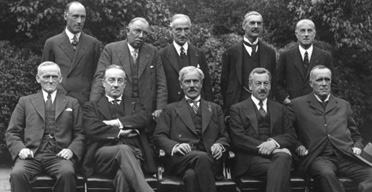 |
Cabinet ministers, August 1931. Back row
(left to right): C Lister, J Thomas, Rufus Isaacs, (Lord Reading),
Neville Chamberlain and S Hoare (Viscount Templewood).
Front row (left to right): Philip Snowdon, Stanley Baldwin,
prime minister Ramsay MacDonald, H Samuel and Lord Stanley.
Photograph -Courtesy Guardin, UK, Source: Getty Images |
Crisis in Britain
On October 27th, 1931, the
Ramsey Macdonald led “National” Government (Conservatives and Liberals coalition, fearful of the rising Labour Party) in Britain won a huge majority of 554 MPs of 615. The economic crisis of September (misnamed as the Indian Currency Crisis), ensuing Depression era problems in the US, the Weimar Republic problems - and other issues pushed this ‘National’ government to
ram through a series of measures (page 130-131) that depressed silver prices, inflated gold prices and raised interest rates in India.
Done over the
protests by Gandhiji, trade bodies and merchants and threats of
resignation by the Viceroy and his Executive Council, the resulting
‘money famine’ (page 155) had the
Lord Willingdon ecstatically say ‘
Indians are disgorging gold.’ Indians have a different reason to revile
Neville Chamberlain, who with great satisfaction said “…The astonishing gold mine that we have discovered in India’s hordes has put us in clover …” after impoverishment of the
Indian serf.
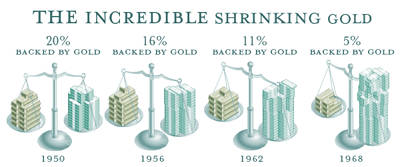 |
| More currency, less gold. Drawing courtesy - imf.org |
The Nixon Chop
On the opposite side of the world, a beleaguered Indian Prime Minister was celebrating 24 years of Independence with a
“ship-to-mouth“ economy, dependent on
PL-480 grain. Private gold reserves in the Indian economy after nearly
25 years of post-colonial rule, were steadily rising. Over the next
10 years, the Western world (and most of the rest) blamed OPEC for post-1971 inflation, gold scaled US$800 an ounce; the Hunt Brothers launched their bid to corner the silver market; stagflation made an entry and Soviet power grew.
Nixon Chop, itself the result of many years of gold reserves erosion, was one in many steps that brought the US$ to its knees - only to be saved by the Oil dollar tango.
From the 1960-1990, the Big Issue for people across large parts of the world was Big Crime. The 1960-1990 peak in organized crime, globally, is interesting due to the synchronized time frames - across USA, Europe and India.
In India, the rise of the underworld was delayed by a decade - as was its decline. India’s underworld, centred in Mumbai, at its peak, intruded into trade unions, films and entertainment, gambling, real estate, extortion and smuggling. The specter of Dawood Ibrahim haunts India-Pakistan Governmental relations - even today.
From 1939, (the start of WW2), gold imports into India, the world’s largest market and also the largest private reserve of gold, were controlled or banned. Not only the largest, but
Indian reserves of gold, are also the only significant reserve in the world without a history of war, genocide, slavery or loot, (unlike US, UK, Canada, Australia) or to due nature’s bounty (unlike South Africa, China, Peru, Ghana, etc.).
The first effect of restrictions on gold imports in India was on prices. Indian gold prices, on an average, were 30%-40% higher than international prices. The other thing that happened was that gold imports went underground. Gold imports (illegal), called smuggling,
spawned the biggest criminals that India has seen.
The common threads in this were, of course, America, drugs, underworld, war, corruption, warlords - but what made all this possible was
Indian appetite for gold.
All this was made possible by the Indian hawala system of money exchange. Hawala made money transfers safe, instantaneous, at a low cost. Traditional Indian ships from a thousand ports in Goa, Maharashtra and Gujarat sailed with this contraband and brought back gold.
 |
Drug production centres surround India -
Golden Triangle & Golden Crescent |
The countries comprising these Golden Triangle /Crescent are India’s neighbours. The Indian underworld transported drugs through India. These drug shipments originated, were acquired, grown and traded from the Golden Crescent and the Golden Triangle.
The US eliminated gold ownership restrictions in 1975. India followed. In 1992, India started its first hesitant steps towards legalizing gold imports. By 1995, these import control laws had been diluted to near non-existence. With the dilution of restrictions on gold imports came the abatement in the biggest crime wave in modern history.
Today, the abatement in organized crime is ascribed to vigourous efforts by the police and legal systems. The earlier lack of success is conveniently forgotten. Many
‘encounter’ specialists claimed credit for the reduction in the power of the India’s underworld. Much like the fading away of the mafia in the US and Italy, in India too, after the gold trade was legalized, the mafia’s source of power, liquidity, earnings, profit were taken away. With it came the underworld’s loss of power and influence. And that coincided with the
reduction and control of organized crime from the US and Europe and India. And an end to the greatest crime wave in the modern history
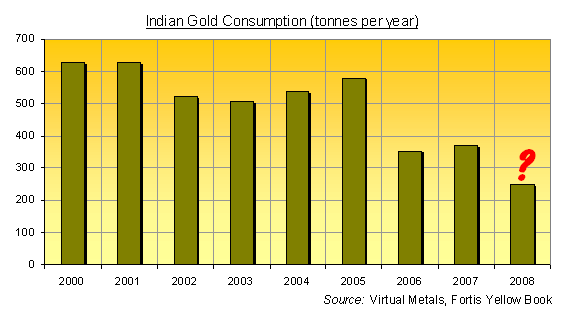 |
| Indian gold consumption (Click for larger image.). |
So, why this desperate poverty
With global monetary system in a flux and the decline of the dollar (especially after
the Plaza Accord), the perceived utility of gold and the
price outlook of gold has been positive. After
the Nixon chop, at an estimated 15,000-18,000 tons, India was in a position to create instruments, obtain leverage and create wealth from the world’s largest gold reserves.
Is the US likely to give up the central role?
Unlikely! Let me correct myself! Pretty damn unlikely!!
What are they likely to do! Some of the older measures by which gold was transferred from the old (and the new) world to Western world are no longer possible.
- Mask purchases
- Build up gold positions
- Take physical possession of gold (Avoid Czech Gold, Montagu Norman & BIS Scam)
- Look at a positive outcome to a war scenario
then that country will be able to bolster their gold reserves position by: -
- About 10,000-15,000 tons
- Limit the cost of purchase
- Make it economically unviable for anyone else to match them
The only country that can (currently) match these criteria is the USA -
and China.
The
US GATA Committee has been running a low profile campaign on
gold price manipulation. This attempt, if successful, at
increasing gold prices will possibly make it difficult for Indians to buy gold in larger quantities. The Indian Central Bank, preoccupied with a developmental agenda, is in no position to take up this challenge.
From an Indian standpoint
While the silver lining is private reserves, we have a blinkered RBI & GOI response. India has one of the lowest monetary reserves of gold in the world. Against a
global average of 10.5% RBI holds only 3.4% of its reserves as gold. The EU holds 40% of its reserves in gold and USA - 70%.
Importantly: -
- Is India in a position to militarily defend these reserves
- Does the GOI and the RBI have any strategic intent vis-a-vis gold
Making the job easier for the GOI and the RBI are Indian economic habits of the centuries that have allowed this build up of gold reserves. India stands at a historical cross road. Are Indian economic and political minds at work to
exploit this window of opportunity. Or will it be a wasted chance.
Gold and War
This short look at Western history makes the linkage between the pattern of gold ownership and war becomes clear.
 |
| Regional gold holdings |
What Should We Do With Gold
Just sell it to people. From all the countries of the world.
The world financial organization should limit control of global gold output by any mining organization to 10% or a single mine - which ever is lower. Gold holding should be widely dispersed, as widely as possible, amongst individuals - like
the Indian gold possession model. No national government, in
the new financial architecture should not be allowed to have more than 250 tons of gold - to progressively reduce to 50 tons.
What this will do is disperse gold holdings among the citizens of the world - and dilute the ability of nations to wage war! National Governments (like the US), have used
gold looted from their own citizens (and others) to deprive other peoples of the world of gold - and wage war.
What we should not do?
Good Ole’ Gold Standard
The simplistic logic of this theory is that the world should ‘go back’ to
the Gold Standard - or as some put it, improve the ‘corrupted Gold Standard’ of the 19th century, and then everything will be fine. All currencies of the World, should be indexed to Gold - and then everything should be fine. Currency can be redeemed against gold - and gold reserves equivalent to currency should be kept as reserves. This will kill inflation, stop war, make politicians honest, make tax payers honest, citizens hard working and business efficient.
In short a magic bullet.
Two years ago …
its (gold) reserves by 454 tons to 1,054 tons through domestic purchases and refining scrap metal,
Hu Xiaolian, head of
the State Administration of Foreign Exchange, said in an interview with the Xinhua News Agency today. China, the world’s biggest gold producer, has increased its holdings before, Hu said in the interview carried on the administration Web Site. They rose from 394 tons to 500 tons in 2001 and to 600 tons in 2003. The U.S. has the world’s biggest gold holdings at 8,134 tons, followed by Germany with 3,413 tons, World Gold Council data show. France has 2,487 tons and Italy 2,452 tons, while the IMF has 3,217 tons, according to the council.
The increase makes China the world’s fifth-largest holder of gold, just ahead of Switzerland, and among the six nations plus the International Monetary Fund that have reserves of more than 1,000 metric tons. Although Hu did not elaborate on where China had sourced the additional bullion, her comments were interpreted as meaning they came from domestic sources and may included refining of scrap metal. Traders also say the gold was accumulated systematically over a number of years. Last year China ranked as the world’s largest gold producer with 12.2% of world output, equivalent to 288 metric tons. The U.S. ranked second with a 9.9% share, or 234 metric tons.
China should increase its gold reserve from 600 tons to about 2,500 tons in a short term and to 3,000 tons in a long term to cope with the versatile exchange rate risks, said Teng Tai, an economist of China Galaxy Securities Company.
Of course, this really does not mean much - except that it may keep gold prices on boil. Whether a currency is backed by a 5% or a 10% gold reserve may not mean much, in
this era of rampant use of (not just by the US of A) “a technology, called a
printing press” as an economic tool. For long term economic stability, gold needs to be in the hands of individuals - and not Governments.
 Chinese were made to cut their queue - pleated hair braids. This diktat was enforced in 20 days time. Sun Yatsen and later Mao Ze Dong made the Chinese change their dress styles too. The effect of this westernisation - an enduring sense of followers. The Chinese add a western name to their Chinese one - Michael Tang, Bruce Lee, Jerry Yang, Tommy Tang, Tommy Chi. In Hong Kong and Macao, white tourists are royalty. Chinese companies routinely parade White, Western investors - and the Chinese investors follow. Western marriage ceremony, Chinese couples think, is very romantic. The Christian Church wedding is common in China.
 1984 Election
 He is poor. He is not the rich Indian. He typically should be swayed by promises and subsidies. But he can be a very perceptive. He has never given the negative agenda of the Leftists a major opportunity.


