 |
| Elephants were widely used instead of engines - due to engine shortage and easier manueverability of elephants |
Romancing the Raj
Modern Indians carry this rather ignorant impression that Indians railways was a departing gift by the British to independent India. This is especially true of post-Independence, 2nd and 3rd generation Indians, who never travelled or saw the colonial railway system trains.This impression is aided and abetted by Western media too. Recently, Robert Kaplan writing in The Atlantic gushed how the "British, by contrast, brought tangible development, ports and railways, that created the basis for a modern state" of India.
As though, India could not have 'bought' or developed railway technology on its own - from or without the British. After all India has developed a significant air-transport system. Or the comprehensive road network - which is getting further expanded and upgraded.
A further examination of facts exposes a completely different picture about the British claims about Indian Railways also.
Indian Railways
After the boycott of the Simon Commission, from 1927, and the death of Lala Lajpat Rai (Nov 17, 1928), it was clear (especially to the British) that their days were numbered. Britain enacted The Government of India Act, first in 1919 and then in 1935. Facing problems at home and abroad, the significant British interest in India was extraction of remaining wealth in Indian hands.
Indian Railway system too suffered from this approach. Especially after WWI, the Great Depression and the currency crisis, starved of investments and renewal, Indian railways suffered.
During WW2, nearly 40% rolling stock from India was diverted to the Middle East. More than 50% of the track system was the outdated metre gauge and narrow gauge. Track systems were nearly a century old. 40% of the railway system went to Pakistan. 32 of the forty-two separate railway systems operating in India, were owned by the former Indian princely states. More than 8000 outdated steam engines were used as motive power – and less than 20 diesel locomotives were in use. Apart from elephants and people - called as 'hand-shunting' in Indian Railways lingo.
 |
| Elephant shunting a train on the Bengal-Nagpur railway. Picture quality makes it probably from WWII period. |
So much for the British gift of railways to India.
Rampant extraction
The railways run by the Indian princely states became party to the collusive price fixing systems. Like this extract (linked to the right) shows, all the business went to the British engineering yards. To this add the guaranteed returns systems, and what was achieved was something else.
"The guarantee system did not encourage cost control, and, at an averae cost of BP18,000 per mile, the Indian railways were some of the costliest in the world. (from Another reason: science and the imagination of modern India By Gyan Prakash, page 165).
Indians took to railway travel - quickly, easily and in large numbers.
Indians enthusiastically took to train travel from the start. This confounded the arguments made by some who suggested that considerations of caste and religion would lead many South Asians to shun train travel because they would not agree to the close personal proximity sitting or standing in the coaches required. Women for reasons of modesty or demands of seclusion were expected to be particularly resistant to rail travel. Others argued that poverty would make travel by train impossible for all but the well-to-do. In the event many of all castes, classes and gender traveled by train. (from Engines of change: the railroads that made India By Ian J. Kerr.).
Even though the poor Indian passenger was more than 80% of the traffic, he was always short-changed.
Third-class passengers quickly became and remained the most numerous passengers and the railroads' largest source of revenue from passenger traffic. High volumes-87 percent of passengers carried in 1902 traveled in third-class-more than compensated for low fares. (from Engines of change: the railroads that made India By Ian J. Kerr.).
Safety last
Starved of investments and maintenance, the railways infrastructure at the time of British departure was crumbling. Colonial British (subsequently, the Indian also) response was to affix the blame onto the employee at the lowest rung and move onto the next one accident.
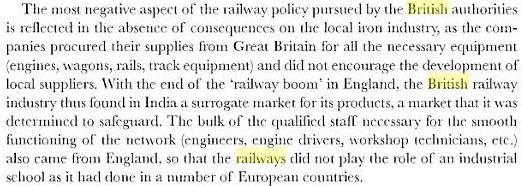 |
| Extract from 'A history of modern India, 1480-1950' By Claude Markovits, page 433. Click on picture for larger text. |
Post-independence India continued with this practice – till LB Shastri called a halt to this. In 1956, the Madras-Tuticorin express plunged into a river when when a bridge at Ariyalur (Tamil Nadu) was washed away in floods. 144 (some records suggest 156) passengers died. He resigned from the Union Cabinet – claiming moral responsibility for the railway accident.
This resignation saw LB Shastri become a political legend. This (resignation) also changed the mindset of the Indian Railways. After fresh elections of 1957, one year later, he was re-inducted into the Union Cabinet.
Steadily, over 30 years, Indian railways infrastructure was upgraded, accidents decreased.
What we see today
In 1952, it was decided that IIIrd class passengers deserved fans and light - and it took another 7 years to implement this decision. Elephants used for shunting wagons, box-cars, finally got a respite after WDS-4B shunters were introduced by Chittranjan Locomotive Works in 1969. Safety bars in windows were introduced on night trains in a phased manner over the 1970s. Till then, most trains had open windows leading to passenger-safety issues. Earlier, it meant "getting into a third-class general compartment — through the window, literally pushed in by someone on the platform. Well, now all the windows have a grill provided for the safety of the passengers".
It took a non-Congress Government in 1977 to change the face of Indian Railways. Prof.Madhu Dandavate, the Railway Minister in the 1977 Janata Government started the railway renaissance in India. 3rd class railway travel was abolished. Wooden-slat seats were abolished. Cushioned 2nd class seating system was made minimum and standard. Train time tables were re-configured. Reservation systems improved. Railways started getting profitable.
The de-colonization of Indian Railways began effectively in 1977 – 30 years after British departure. Symbolically, that was also the year that the Rail Museum was set up. The progress after that has been remarkable. Without going into the merits of safety and comfort, today Indians can travel at significantly lower cost. For a US$5, an Indian can travel for 1000 km - compared to nearly US$100 for 1000 km (gold-adjusted dollars).
All this when only 25% of Indians travel by rail at least once a year.
 |
| OLD FAITHFUL: An 80-year-old elephant shunting a railway boxcar in 1945, Picture courtesy - The Times of India, Dated 27th February, 2010 |
The benign British
Should we complain so much, if we inherited a decrepit, run down, accident prone, investment starved railway system with outdated technology from the British – though financed by loot from India?
Even though it took India 40 years, to modernize the colonial railway system, we should be thankful. Remember, they could have uprooted the rails, and taken away the wagons and engines. After all, Indian Railways was the biggest scrap iron collection in the world at that time.
Till Lal Bahadur Shastri’s resignation – the poor Indian railway-man was routinely blamed for railway accidents – by his British, and later the Indian bosses also.
Related Articles
- Will Indian Trains Ever Be Safe? (forbes.com)


 This cartoon which I saw on a blog, captures the entire charade about Iraq, Iran and the Middle East.
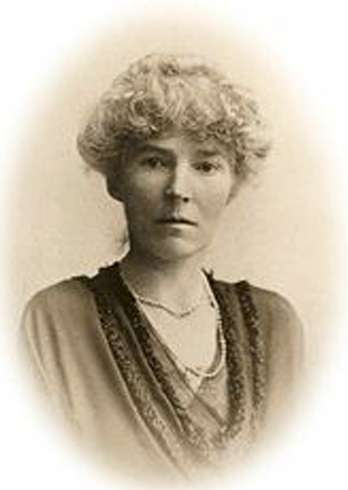 This new King did not even know his kingdom - and he was taken around by his new makers. Similarly, an amateur like TE Lawrence (never mind the propaganda) was used to determine the fate of the Middle East.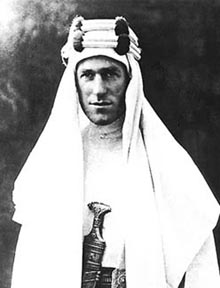


 On one side were the Austro-Hungarian Empire ruled by the Habsburgs (whose heir apparent was killed), The Ottoman Empire (out of Turkey), which could obviously not support assassins of royalty - and Germany.